
Analyzing The Ambiguity Over The American-NATO Arms Arrangement For Ukraine

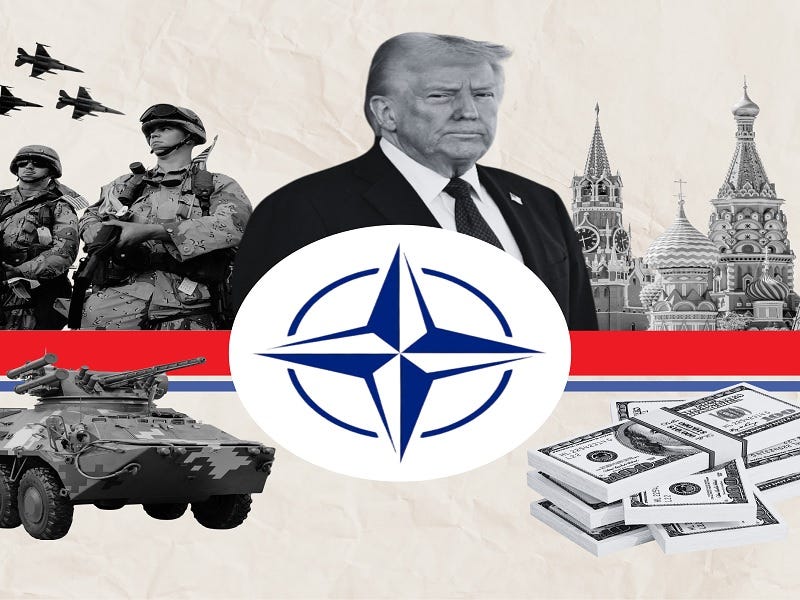
The Europeans’ compliance or lack thereof will play a crucial role in the conflict’s future course.
The offensive dimension of Trump’s new three-pronged approach to Ukraine involves the sale of American weapons to NATO who’ll in turn transfer them to Ukraine. This aligns with what Trump told NBC several days prior to the aforesaid announcement. According to Reuters’ sources, however, “Trump presented a framework - not a fleshed-out plan”, and some of the six countries that NATO chief Rutte mentioned will participate in this scheme allegedly only found out about it during that time.
Other reports then circulated about France, Italy, and Czechia’s refusal to participate on various pretexts ranging from their principled support for the European defense industry, which would struggle to fulfill its potential if EU countries buy more expensive US arms, to simple budgetary concerns. The resultant ambiguity over the American-NATO arms arrangement for Ukraine that Trump announced accordingly raises questions about what’s really going on. There are three likely explanations.
The first is that there were innocent communication issues between the US, NATO, and the bloc’s individual members, but that’s difficult to believe since everyone just gathered for the latest NATO Summit less than a month ago. This arrangement was presumably discussed during that time. It would also contextualize their agreement to raise defense spending to 5% of GDP, especially if the Europeans expected to purchase more expensive arms for transfer to Ukraine as part of this arrangement.
The second explanation is that nothing concrete was agreed to, at least with all members, during that summit. This would account for why some of them were reportedly caught by surprise and others refuse to participate. In this scenario, Trump’s announcement would have been meant to pressure them into this profitable arrangement to “save face” since all but Hungary and Slovakia (which also won’t participate) have consistently claimed that they’ll support Ukraine “for as long as it takes”.
And finally, the last possibility is that the analyzed media reports are part of a deception campaign along the lines of what Israeli media claimed that Trump and Bibi pulled off ahead of them bombing Iran. This version of events assumes that there’s much more agreement between NATO members behind the scenes than has been reported. The purpose of claiming otherwise would be to get Russia’s guard down ahead of what could be NATO’s rapid rearmament of Ukraine with American weapons.
Whichever explanation(s) one adheres to, more clarity will be forthcoming from Russian media reports, which will reveal the existence of these new arms on the battlefield or lack thereof ahead of the expiry of Trump’s 50-day deadline. If lots of US arms flood into Ukraine, then it’ll show that there was enough agreement and capacity to back up his threat. If not, then he might blame the Europeans for fumbling it, after which he might only impose some secondary sanctions but no longer militarily escalate.
Trump repeatedly said that the Europeans must step up since this conflict is waged on their continent. If enough prioritize other interests over supporting Ukraine “for as long as it takes”, however, then Trump likely isn’t going to have the US once again “lead from the front”, do the “heavy lifting”, and thus let them keep “freeloading” off of it since that would betray his planned reform of US-NATO relations. The Europeans’ compliance or lack thereof will therefore play a crucial role in the conflict’s future course.
Trump’s Ukraine Backflip: How NATO Elites Just Ensnared the US (Again)
Washington Is Being Played. This latest manoeuvre by NATO elites is not just cynical—it’s dangerous.
Date: July 2025
Earlier this week, Donald Trump shocked supporters and critics alike when he announced a convoluted plan to resume arms transfers to Ukraine—despite repeated campaign promises to end U.S. involvement in the war. But the real story is more insidious than a simple policy reversal. What we are witnessing is a clever geopolitical trap, engineered by the EU-NATO establishment, designed to force the U.S. back into leading a European war effort that has failed both strategically and morally.
Let’s unpack what just happened—and what it reveals about the state of the West.
A Cynical Workaround for a Broken Promise
Trump’s public stance has long been clear: No more U.S. arms for Ukraine. Yet, under pressure from both NATO hardliners and the U.S. military-industrial complex, he has now endorsed a workaround that is as absurd as it is revealing.
Here’s how it works:
1. The EU orders and pays for American-made weapons.
2. These arms are manufactured by the U.S. defense industry.
3. On delivery, they are handed over to NATO.
4. NATO then supplies them to Ukraine.
Trump can then claim—technically—that he didn’t approve any direct U.S. arms transfers to Ukraine.
But everyone watching knows what this is: an accounting trick to hide a strategic betrayal of both American voters and geopolitical common sense.
The $300 Billion Mirage
To finance this scheme, NATO strategists floated the idea of using the $300 billion in frozen Russian Central Bank reserves, currently held and managed by Euroclear in Belgium. But the legal, financial, and geopolitical risks are so immense that even the EU’s own mechanisms are pushing back.
Belgium—home to Euroclear—and other legal experts within the EU have refused to approve the outright confiscation of these funds, citing international law, potential retaliatory precedents, and the risk of destabilizing the global financial system.
Meanwhile, the Trump workaround—where the EU would order U.S.-made weapons, then pass them to NATO for Ukraine—has run into another wall: EU countries do not have the money. Nations like France, Italy, Spain, Slovakia, Hungary, and even Germany are either unwilling or unable to fund such a plan at the scale envisioned. These governments are facing domestic economic pressures, military stockpile shortages, and growing voter fatigue over the endless flow of support to Ukraine.
So, the plan falters on two fronts:
• The legal impossibility of using Russia’s frozen reserves.
• The financial reluctance of EU states to take on the bill for what is, in effect, a U.S.- profitable billions-plus transaction.
NATO’s Russophobia and the American Trap
What we’re really seeing is a resurgence of the EU/NATO Russophobia project, with a dangerous twist.
For years, Brussels, Warsaw, London, Berlin and the Baltics have dreamed of a moment where the West could finally defeat Russia militarily. The Ukrainian conflict offered that hope—but only if America led the effort, financially, militarily, and politically.
Now, with Ukraine’s military position sharply deteriorating, the EU elite are making one final gambit:
• Bypass Trump’s promises,
• Manufacture a European-led arms initiative (on paper),
• Then pull the U.S. back in as the ultimate arsenal and guarantor of victory.
This isn’t strategy—it’s entrapment. And Trump has walked right into it.
Reality Check: The War Is Lost Militarily
The brutal truth, ignored in Western media but acknowledged by many military analysts, is this:
Ukraine cannot win this war militarily.
The reasons are obvious:
• Russia’s manpower advantage (140M vs. ~30M)
• Control of the skies and drone dominance
• Superior industrial base and logistics
• Massive reserves of artillery and ammunition
• A weakening and fragmented Ukrainian military, hollowed out by casualties, fatigue, and conscription issues
Continued Western support only prolongs the suffering—while destroying Ukraine’s infrastructure, population, and long-term viability.
The Only Path Forward: A Diplomatic Solution
The time for illusions is over. What’s needed now is a sober and realistic peace framework, one that includes:
• Recognition of Crimea and the Donbas as de facto under Russian control
• A formal commitment to Ukrainian neutrality
• Security guarantees for both sides
• A phased lifting of sanctions tied to compliance
Such a settlement will not be easy. But it is infinitely better than the current path, which promises only more destruction, escalation, and geopolitical fragmentation.
Trump’s Missed Opportunity—and His Final Test
Donald Trump built his political identity on opposing “forever wars.” He has repeatedly criticized NATO freeloading, EU bureaucracy, and U.S. overreach abroad.
Yet, with this latest move, he risks becoming just another American president played by the war lobby—dragged into a European conflict with no exit, no victory, and no mandate.
This moment is his final test:
• Will he confront the NATO elites and say enough is enough?
• Or will he try to appease everyone, and in doing so, lose everything?
Final Thought: Washington Is Being Played
This latest manoeuvre by NATO elites is not just cynical—it’s dangerous.
By creating a convoluted system of proxy procurement and legal fiction, they have successfully pulled the U.S. back into the war it tried to escape. Not through direct confrontation, but by manipulating Trump’s own weaknesses and campaign rhetoric.
Washington needs to wake up. The longer this war continues, the more damage it does:
• To Ukraine’s survival
• To European unity
• To American global credibility
There is no military path to “victory.” There is only compromise—or catastrophe.
The choice is ours. But the clock is running out.
From: https://leonvermeulen.substack.com/
In the case of France, we have a big weapon industry and our government is cutting wildly in our national budget.
So, if French learn that their government throw billions euros to feed the big fat American pig, it could spark extremely serious events. It's a red line for french people. Our "elites" are rotten, sold, corrupted and traitors but then don't want to have their head at the end of a pike.
In Germany, we've seen all kind of chancellor but always clever, harsh and terribly invested by their national interest. So, it's really astonishing to see at what point the current chancellor is purely dumb and US servile. We've never see a German chancellor so restless since Hitler. Mad.
Italia and Spain has the same situation than France.
UK transformed awfully itself in a Monty Python sketch. It's horrible for old foe like us( 800 and) to see a so brillant nation , a so valiant adversary falling so quick so deep. In France we had a terrible suite of unworthy presidents, Sarkozy, Hollande, Macron. But UK is more than one can imagine. It's dumb and dumber and a whole land in psychiatric decompensation.
Here is the sad state of Europe.
I think there's no machiavelli calculations.
Just a continent in terminal phase.
And one must think dynamic.
In ten or twenty years France will really begin to look like a Algerian or sahelian failed state. England will look like Pakistan with rain and Germany a kind of psycho rigid Turkey.