
Analyzing The US’ Reported Plans To Once Again Store Tactical Nukes In The UK

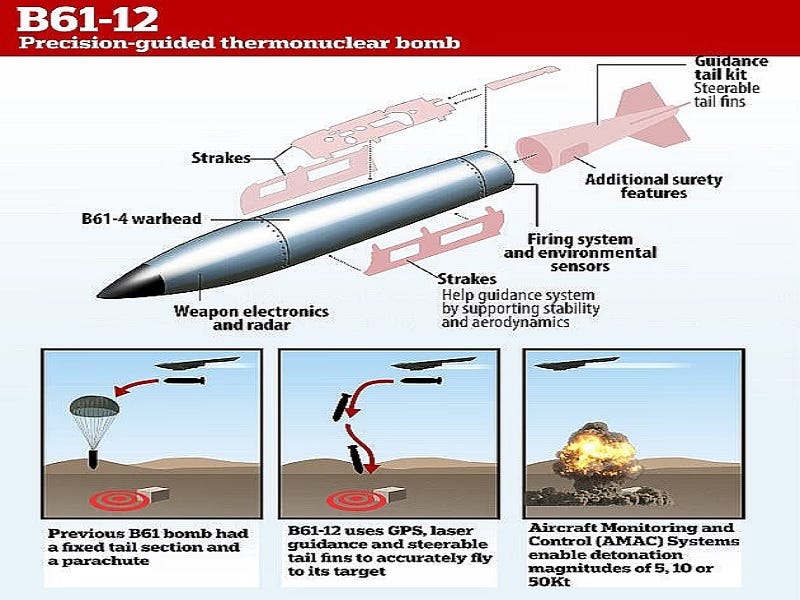
It’s possible that the US – whether under Trump 2.0 or whichever administration, including a possible Democrat one, comes afterwards – might agree to transfer its tactical nukes to Estonia in parallel with a possible British F-35A deployment to the latter’s base there.
The Daily Mail cited Pentagon funding proposals to report in late December that the US plans to once again store tactical nukes in the UK upon renovating Lakenheath Airbase. The project is expected to cost $264 million and be completed by 2031. They added that “The U.K. will receive its (12 F-35A) jets at the end of this decade and it will be the first time it has had an air-launched tactical nuclear weapon since 1998. While it will own the jets, the U.S. will retain ownership of the nuclear weapons they come with.”
Although they also wrote that “[this] represents confirmation that American nuclear weapons will return to Britain for the first time since President Barack Obama withdrew them 17 years ago”, that was assumed in June after two announcements. The Ministry of Defense revealed that London will purchase 12 F-35As from the US and join NATO’s dual-capable nuclear aircraft mission. The Defense Minister then confirmed in November that the US would retain control over the nuclear weapons involved.
What makes the Daily Mail’s report significant is that it was published amidst the ongoing Russian-US talks over Ukraine as Putin’s Special Envoy Kirill Dmitriev met with Trump’s Special Envoys Steve Witkoff and Jared Kushner in Miami that weekend to discuss this. The signal being sent was that any grand deal with Russia for reforming the European security architecture after their proxy war ends won’t result in the US hanging its NATO allies out to dry as proven by its planned nuclear deployment to the UK.
Some of its troops in Europe might be redeployed to the Western Hemisphere or the Asia-Pacific, which are respectively the new National Security Strategy’s first and second priorities, but this isn’t akin to “selling Europe out” to Russia or agreeing to “a new Yalta”. The purpose would solely be to help alleviate some of Russia’s concerns for better managing their security dilemma all while reassuring NATO allies of its reliability through a continued presence on the mainland and the resumed nuclear one in the UK.
Readers should also remember that the US already stores nuclear weapons in Belgium, Germany, Italy, the Netherlands, and Turkiye so once again storing them in the UK shouldn’t be seen as too provocative by Russia since it’s geographically more distant from its borders than all of the aforesaid NATO countries. Nevertheless, resuming the UK’s role in the US’ nuclear-sharing program comes with additional risks due to London’s military presence at Estonia’s Tapa Army Base, whose government wants to host its F-35As.
The Estonian Defense Minister first floated this in July, the strategic significance of which was analyzed here at the time, and then reaffirmed his interest in September. It’s therefore possible that the US – whether under Trump 2.0 or whichever administration, including a possible Democrat one, comes afterwards – might agree to transfer its tactical nukes to Estonia in parallel with a possible British F-35A deployment there. The UK would then function as the tip of the US’ nuclear spear against Russia.
To be clear, these plans remain in the realm of speculation for now, but they also can’t be ruled out. If a fellow MAGA ally such as Vice President JD Vance succeeds Trump, then this likely won’t happen unless in the far-fetched event of ties with Russia deteriorating for whatever reason, but a Democrat successor might flirt with this or actually go through with it precisely to provoke a crisis. Russia is accordingly expected to closely monitor this deployment due to its potentially outsized strategic significance.
Let’s hope that Starmer’s likely exit from the political scene will return a measure of sanity to the UK’s present absurd posturing on European security issues.
The deployment of NATO aircraft or nuclear launchers east of Germany, and even more so in the Baltic states or Finland, should be a casus belli for the Russians. If this happens, it would vindicate all those who have accused Putin of weakness and indecisiveness for the past four years.