

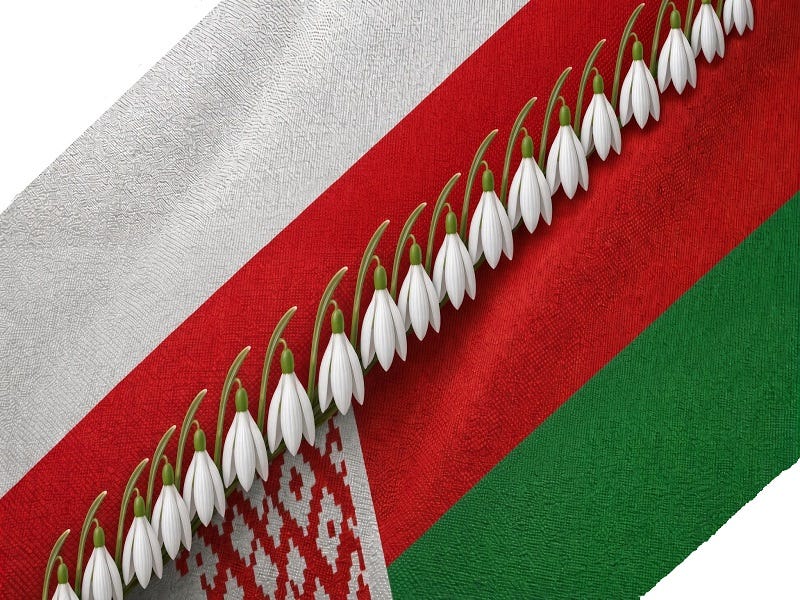
Sikorski’s historic meeting with his Belarusian counterpart, and especially his revelation that “meetings are also taking place with other ministries and at other levels”, suggests that more is going on behind the scenes along the western flank of the “cordon sanitaire” than the public is privy to.
Polish Foreign Minister Radek Sikorski met with his Belarusian counterpart on the sidelines of the UNGA last week in the first talks between their countries’ top diplomats in a decade. He said that they were facilitated by the relative normalization of the border situation as well as Belarus’ recent release of Andrzej Poczobut, who Warsaw considered to be a political prisoner. He added that other ministry meetings are now taking place and that “a snowdrop can bloom if the weather is favorable.”
The Belarusian Foreign Ministry soon thereafter posted on X that “snowdrop diplomacy is a nice restart. But we’re in it for the harvest. Let’s plant an orchard – it needs nurturing every year, not once a decade. Minsk is ready to host talks.” For those who aren’t aware, snowdrops symbolize the spring thaw, so the new Belarusian-Polish “snowdrop diplomacy” could lead to a thaw in the New Cold War if successful. Some background information is required in order to bring casual observers up to speed about all of this.
Trump 2.0 initiated a rapprochement with Belarus that’s taken the form of phased sanctions relief in exchange for the release of what Washington considers to be political prisoners. They’re now on the brink of a massive potash deal too. Poland is the US’ top ally in Central & Eastern Europe so it was only a matter of time in retrospect before Warsaw was brought into the mix. Recently, Sikorski has been fearmongering about a Russian strike on NATO, which prompted speculation about a Ukrainian false flag.
With a view towards averting a potentially uncontrollable escalation, it was suggested here that the Belarusian-US rapprochement could lead to a deal whereby the reportedly planned reduction of US troops in the Baltic States is followed by Russian ones in Belarus. If paired with a crisis-control channel between Trump, Putin, and Polish President Karol Nawrocki as suggested here, then NATO-Russian tensions would become manageable and the basis for a new security architecture would be established.
From Russia’s perspective, if it’s forced to choose between a German-dominated militarized EU along the western flank of the new “cordon sanitaire” that’s been assembled around it or a US-backed Polish-led Intermarium, then the latter is arguably more preferable due to posing relatively less danger. For that future to unfold, the abovementioned deal would have to be agreed to, which requires the success of the new Belarusian-Polish “snowdrop diplomacy” that’s a partial byproduct of Russian-US diplomacy.
Just like Russia has begun to rethink its understanding of Poland as proven by Putin’s top aide Nikolai Patrushev recognizing its centrality in the emerging security architecture, so too has Poland begun to rethink its understanding of Russia as proven by Sikorski’s new “snowdrop diplomacy” with Belarus. While it’s premature to predict how far this potential thaw in the New Cold War might go, and the previously shared proposal could easily be derailed, it nevertheless can’t be ruled out either right now.
Sikorski’s historic meeting with his Belarusian counterpart, and especially his revelation that “meetings are also taking place with other ministries and at other levels”, suggests that more is going on behind the scenes along the western flank of the “cordon sanitaire” than the public is privy to. This doesn’t mean that a breakthrough is imminent, nor that one is inevitable even if it takes a while, just that something has clearly changed for the better. Whether these new “snowdrops” blossom or wilt remains to be seen.
My conjecture: The West tries to soften Belarus before a color revolution; Russia tries to soften Poland into a more neutral position despite what happened in the last 100 years. Belarus tries to gain more independence from Moscow by trying to serve Russian interests as a true buffer state. Poland has not realized it yet, but being a prosperous and strong buffer state between Russia and Germany serves everybody's best interests.
My shallow understanding of Poland is that Poland has been historically sandwiched between multiple strong economies and ethnic groups. When Lithuania and Poland were united, it had a stronger economy and military. Geographically, Poland is located at a crossroads, and in Sun Tzu's words, a land that has to face battles from all directions. Building a strong economy and military should give Polish elites some self-confidence to drift toward neutrality rather than tilting toward one side so completely it bends over.
Cautiously speaking, this might be a hint of a good news