
Evaluating The Report That A Key Crocus Plotter Might Have Been Detained In Pakistan

It’s unconfirmed but plausible.
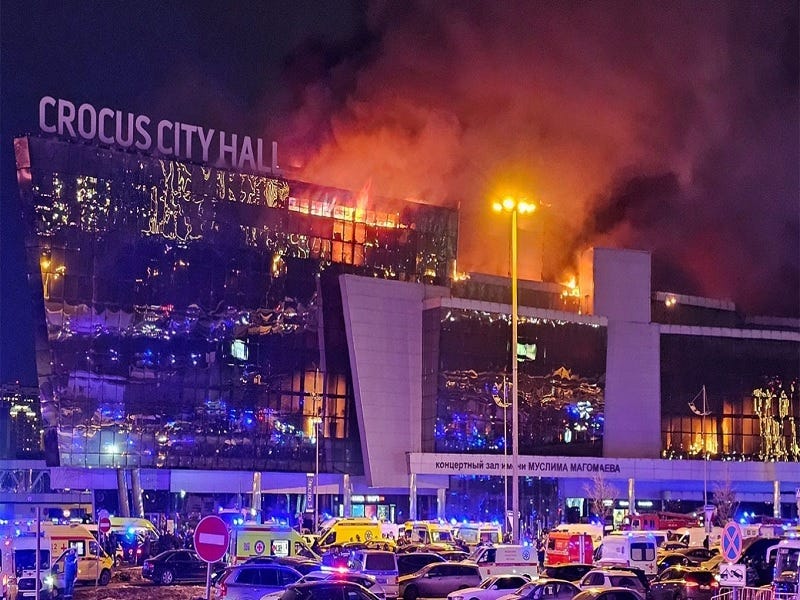
India’s Economic Times reported that a key plotter of last spring’s Crocus terrorist attack, which the Russian authorities determined to have been carried out by ISIS-K in collusion with the Ukrainian military-intelligence agency GUR, might have been detained in Pakistan. According to what they learned, “Moscow had earlier approached Afghanistan to hand over the (Tajik) mastermind of Crocus terror attack but the extremist operative had allegedly slipped into Pakistan by the time Kabul could nab him.”
Publicly financed Russian media have yet to share the report at the time of this analysis’ publication nor have any Russian officials commented on the matter so its veracity remains uncertain. Nevertheless, the known involvement of ethnic Tajiks in the Crocus terrorist attack, ISIS-K’s base of operations being in Afghanistan, and the porousness of the Afghan-Pakistani border make the report believable. Terrorist-designated groups and individuals have also sought sanctuary in and operated out of Pakistan before.
This last point will be elaborated on in detail due to its importance. No evidence has emerged over the past year to suggest that Pakistan played any role in the Crocus terrorist attack, neither at the state level nor through the involvement of non-state actors operating from its soil, but it still wouldn’t be surprising if an alleged Crocus plotter fled Afghanistan for Pakistan like the Economic Times reported. That’s because the country’s ignoble reputation, which was touched upon above, attracts people of this sort.
At present, Pakistan is fighting against the “Baloch Liberation Army” and “Tehreek-i-Taliban” terrorist groups, but India has also accused it of involvement in last week’s Pahalgam terrorist attack that saw 24 tourists massacred solely on the basis of being Hindus after the culprits confirmed their faith. This contradiction of being a victim of terrorism at the same time as being accused of weaponizing it against India isn’t new and has been a staple of regional affairs since the 1990s.
To oversimplify very complex dynamics, Pakistan’s self-admitted support of the US-masterminded Afghan jihad against the USSR gave it the experience required for employing similar unconventional warfare tactics against India, but it also backfired by radicalizing large swaths of society. As radicalized Pashtuns began to wage war against the Pakistani state with the Taliban’s support, the resultant chaos created an opportunity for reviving the Baloch separatist movement, which has also resorted to terrorist tactics.
Observers also shouldn’t forget that Osama Bin Laden was killed by the US in Pakistan, where he’d been living for years in proximity to a military base, thus prompting speculation that continues to this day about how close Pakistan’s de facto military leaders were to him and other terrorists. The corruption and lawlessness that facilitate terrorism along Pakistan’s border with Afghanistan coupled with the country’s ignoble reputation that was just described could explain why that Crocus plotter allegedly fled there.
The Economic Times’ report claimed that “the Pakistani authorities may have detained him”, however, which would be to their credit if true and strengthen their ties with Russia. About that, “Russia & Pakistan Will Comprehensively Expand Cooperation In The Resource Sector” and “The PAKAFUZ Railway Through Central Eurasia Is Making Slow But Steady Progress”, which readers can learn more about from the preceding analyses. They also just held the 11th round of their counter-terrorism working group.
If Pakistan was supposedly able to swiftly detain that suspect, provided that the report is accurate, then it should be able to just as swiftly detain the Pahalgam terrorists’ Pakistani collaborators. For that to happen, India will have to share whatever information it has, which could be passed along via Russia. Indo-Pak ties have deteriorated after this terrorist attack, Pakistan just invited Russia to participate in a neutral investigation, and Russia is friendly with both so it’s sensible to have it play this role.
Moreover, from the perspective of Indian interests, it’s important for Russia to be informed of all the facts that have been established thus far for proving Pakistan’s complicity in the Pahalgam terrorist attack. Pakistani Defense Minister Khawaja Asif has gone on a media offensive in Russia by engaging with publicly financed RIA Novosti, Sputnik, and RT, but the positive effect that this might have had on reshaping perceptions of its alleged complicity could be counteracted by India’s aforesaid intelligence.
It’s for this reason that India might have already discreetly shared its findings with Russia, whether in the spirit of their strategic partnership or with the intent of Russia then passing it along to Pakistan for requesting that it detain the suspects, or it could soon be planning to do so for either reason. The same goes for the US, which recently thanked Pakistan for arresting an ISIS-K terrorist connected to August 2021’s infamous Kabul Airport terrorist attack, since American pressure on Pakistan couldn’t hurt either.
Circling back to the lede about how a key Crocus plotter might have been detained in Pakistan, its larger relevance is that it reminds readers after Pahalgam that some terrorists seek sanctuary in Pakistan, thus prompting the present analysis about why that is. As for the report itself, it’s unconfirmed but plausible, with more clarity expected soon. Independently of this, India is expected to share its findings on Pahalgam with others like Russia if it hasn’t already, which could convince them of Pakistan’s complicity.
If the attack against Crocus City Hall sources back to an Ukraine/ISIS-K alliance that will present a long-term issue for Ukraine. Russia will evaluate the event as something that Ukraine could achieve/motivate only with the rich cash flow provided by Western sources. In turn, this will justify in their eyes a drive to dismantle Ukrainian capacity in the future for any similar activities. The whole of the suicidal Kursk operation, Crocus and various other acts like the presence of biological warfare labs in Ukraine point toward a will to employ psychological warfare against the Russian Federation and this is a complete miscalculation. These acts will only harden Russian public support for the war. These methods point toward some sick minds that are driving to cause maximum damage to both nations, Ukraine and Russia at the same time.
An interesting analysis by Francisco Gil-White was written on the India-Pakistan conflict here:
https://franciscogilwhite.substack.com/p/india-pakistan-nuclear-war-cold-start-or-a-clean?utm_campaign=email-half-post&r=hevwr&utm_source=substack&utm_medium=email
Apparently the Pakistani military have become radicalized into a jihadi force over a period of years.
Gil-White quotes a scholar as follows:
"The story, however, does not and cannot end there. As noted at the beginning of this chapter, the army has sustained steady infiltration by Islamist militants. Military elites may well have a complex understanding of the multiple purposes Islam serves, but it is far from clear how ordinary officers, much less the enlisted ranks, interpret these incessant references to Islamism, jihad, and perpetual enmity with India, especially when they coexist with some six decades of explicit mobilization of Islamist militants [jihadi terrorists—FGW] under the banner of Islam.”
Professor Gil-White discusses the nuclear capabilities of both states and their nuclear doctrines, and explains how the conditions necessary for MAD are not met in this situation, primarily because Islamic jihad is inherently a death cult and their rationality can break down at any time. Also Pakistan has a nuclear first strike policy while India's policy which has been non-first strike for years, is now favoring a bit more flexibility on this issue.
The other factor in the equation of the Pakistan-India conflict is the CIA-Saudi Arabia funneling billions of dollars through the ISI to fund jihad against the Soviets in Afghanistan.
"With Reagan at the helm, and allied with the CIA, Pakistan cultivated a network of radical madrasas (Islamic schools), training camps, and jihadi groups to serve as ideological and logistical infrastructure to create the mujahideen or Afghan ‘holy warriors.’ These radical jihadists, if the redundancy be allowed, were represented by Reagan to Western audiences as ‘freedom fighters.’
So you have the CIA having contributed to the radicalization of the Pakistani military over many years, which is now involved in a conflict with India that could become a nuclear conflict if things deteriorate further. The CIA's arms extend also into Ukraine and the EU fomenting of perpetual war against Russia.
It is becoming pretty clear who the bad actors are in these conflicts
Thank you to Andrew Korybko for your article on the escape into Pakistan of the alleged Crocus City Hall attacker.. Your analysis always improves my understanding of the geopolitical world.