

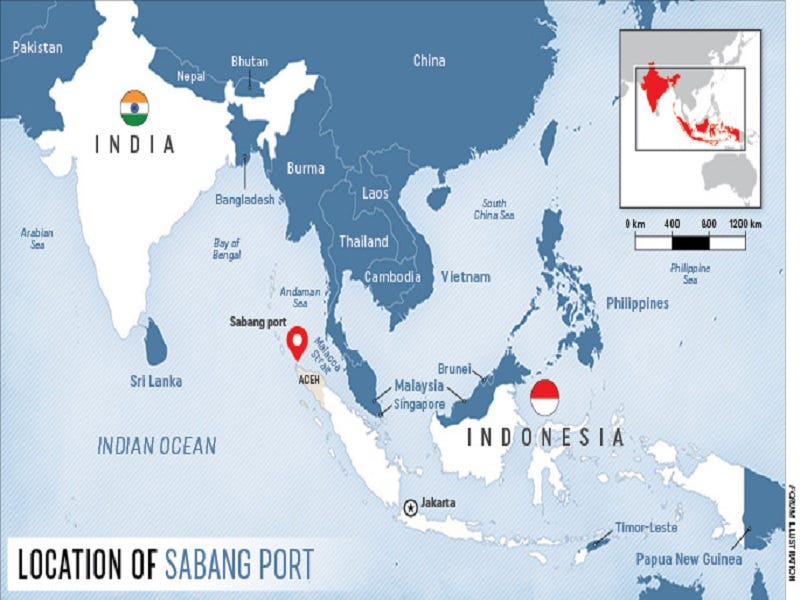
They’re now in a position to impose a naval blockade against China on one of the approaches to the Strait of Malacca as a deterrent against China unilaterally upsetting the status quo in its territorial dispute with India and its maritime one in the South China Sea that unsettles Indonesia.
One of the takeaways from Indian Prime Minister Narendra Modi’s recent trip to Indonesia was an agreement to jointly develop the latter’s Sabang Port, which is on Weh Island, the closest Indonesian island to India’s Andaman and Nicobar Islands. Although officially driven by commercial interests, this initiative is strategically significant given that the island chain stretching from the Andaman Islands to the Nicobar Islands and Weh Island controls passage between the Andaman Sea and the Bay of Bengal.
In terms of the bigger picture, this is the main gateway between the Indian and Pacific Oceans since the Andaman Sea connects to the South China Sea via the famous Strait of Malacca, thus meaning that the bulk of trade between these oceans traverses Indian and Indonesian waters. Both of them are practicing complementary balancing acts due to their shared threat assessment of China, which is embroiled in a territorial dispute with India and whose claims over the South China Sea unsettle Indonesia.
Indonesia’s new “Major Defense Cooperation Partnership” with the US has been widely assessed as laying the groundwork for those two to close the strait to China in the event that it ever enters into conflict with either of them. Likewise, India’s joint development of Sabang Port and closer military-technical cooperation with Indonesia sets the stage for them to do the same in support of the other if either of them enters into conflict with China, thus establishing the basis for informal allied relations.
The US’ rotational forces in Singapore could assist them with boarding Chinese ships that try to break their blockade just like the US proved that it’s capable of doing with Iranian ones that tried to exit the Gulf and members of Russia’s so-called “shadow fleet” elsewhere. Nevertheless, just like with the “NATO 3.0” concept that’s being implemented in Europe, the US’ NATO-like AUKUS+ that it’s assembling in Asia will likely also see result in a preference for autonomous allied activity instead of full reliance on the US.
Such an approach suits India and Indonesia just fine since they’re fiercely proud of their sovereignty. Neither wants to be dependent on anyone else, ergo their complementary balancing acts, with their joint development of Sabang Port aiming to lay the groundwork for the joint maritime containment of China with an eye towards deterring it from intensifying its competition with either of them to the point of conflict. This goal advances US interests but importantly doesn’t make them US puppets.
That’s because their interests are independent of the US’ even though they’re aligned with them. This overlap of interests with the US and the leading role that those two aim to play in the maritime containment of China if it enters into conflict with either of them makes them reliable pillars of the Asian security architecture that the US wants to build across the Indo-Pacific. All that the US has to do is supply them with relevant equipment and intelligence to empower them to implement this task on their own.
If any blockade is imposed, then China might carry out crippling strikes against India, but China also knows that India has the capability to retaliate. These calculations therefore suggest that any unilateral Chinese moves in disputed Indian territory could trigger a fast-moving and very serious escalation sequence that could easily spiral out of control. Whether China finally resolves, continues to freeze, or dangerously escalates its dispute with India in light of this new strategic dynamic remains to be seen.
It looks more like sterile agitation—in France, we say 'tartarinade' (from Tartarin de Tarascon, a novella by A. Daudet mocking the boastful bravado of a poor hunter). First, there are other passages—Lombok-Makassar, Ombai-Wetar. Second, if the West and its Asian puppies amuse themselves by blocking the straits, China can play by blockading South Korea and Japan, or, with long-range weapons, destroy the Panama and Suez canals for several months. Moreover, in the event of a blockade, China will have its cargo ships and tankers escorted by warships, and if anyone fires on them, it's war. I don't understand these boastful displays except as a demonstration of firmness for domestic political purposes and, perhaps, to lull the USA to sleep...
Great report!
Although I don't quite understand why having Sabang would make much difference in the west's or India/Indonesia's ability to block the Strait of Malacca. India already controls the Andaman and Nicobar Islands.
I would think that what ever US Forces are in Singapore could blockade the Strait at it narrowest point - the southern end of the Strait. Indonesia's First Fleet Command in nearby at Tanjung Uban. Indonesia's Navy and Marine Corps seem to be significant forces.
I suppose they would also have to blockade the Sunda Strait. Which I just learned used to be the main route before the Suez Canal opened in 1869. 1869! I would have guessed it was made much later. Turns out one can learn stuff from Wikipedia!
Also it has a deep sea port and was open to the Indian Navy since 2002.
Also found out there was an insurgency in Aceh province from 1976 and 2005. Which slowed development of the port. It was also slowed by the earthquake and tsunami of 2004.
Although I can understand why India would want to do this from a trade/economic view.
I also found this article about the subject from 2019 :
https://timesofindia.indiatimes.com/india/why-india-is-developing-its-maiden-deep-sea-port-in-indonesia/articleshow/68511228.cms
It includes "an Indian naval ship, INS Sumitra, visited Sabang for the first time last July", which I suppose contradicts the above statement that it has been open to the Indian Navy since 2002. Although maybe it was open since then and only first visited in 2018.
Also " India is also strengthening its forces in the Andamans. The Indian Navy recently commissioned its third (and India's fourth) air base in the islands."
But perhaps you know all this and can explain it to me further.
Cheers,
Chris
Other links :
https://en.wikipedia.org/wiki/Sabang%2C_Aceh
https://en.wikipedia.org/wiki/Insurgency_in_Aceh
https://en.wikipedia.org/wiki/Indonesian_Navy
https://en.wikipedia.org/wiki/Indonesian_Marine_Corps