
India’s New Multi-Alignment Trend Prioritizes Middle Powers For Tri-Multipolarity Purposes

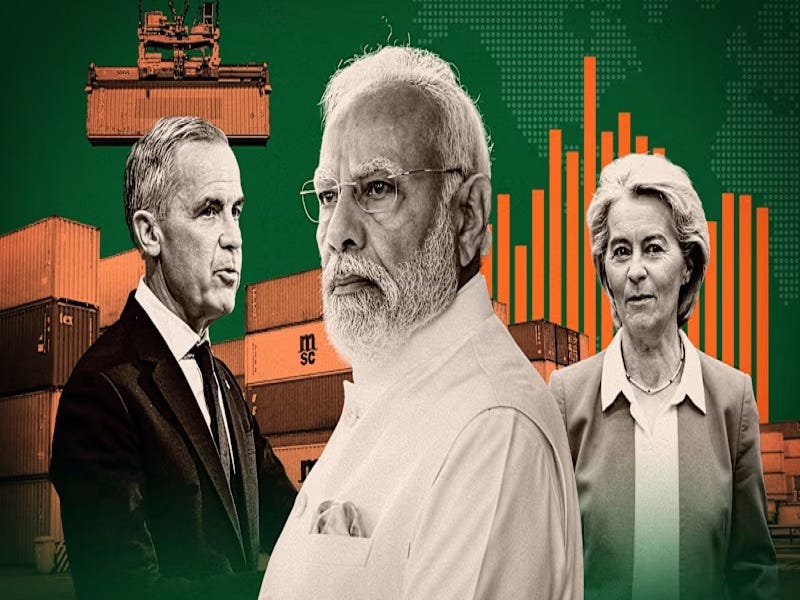
By expanding the scope of “tri-multipolarity” beyond its proposed Russian-centricity to include a wide range of middle powers, India is pragmatically adapting to the global systemic changes caused by Trump 2.0’s policies, importantly aligning with others who’ve faced its tariff pressures too.
The Financial Times wrote about “How Trump is pushing India to hedge its geopolitical bets”, which argues that the US’ pivot to Pakistan prior to early February’s Indo-US trade deal and its punitive tariffs over the six months prior for India’s import of Russian oil changed India’s grand strategic calculations. Instead of “pivoting towards the US” as they claimed it was doing, India is now “rapidly deepen[ing] its ties with ‘middle powers’ — countries including Japan, Brazil and Canada — as well as the EU”.
To that end, India recently clinched a long-awaited trade deal with the EU, entered into a rapprochement with Canada in pursuit of reviving the trade deal that stalled once ties deteriorated in late 2023, and continues proudly presenting itself as the Voice of the Global South due to being its largest member. The Financial Times described this policy as building “resilience” amidst the increasingly chaotic global systemic transition that was made all the more turbulent due to Trump 2.0’s policies over the past year.
This approach can be considered a variant of the “tri-multipolarity” model that was proposed here two years ago, albeit with India now partnering with a wider range of countries for building a third pole of influence between the American and Chinese superpowers than just Russia as was envisaged. That said, it would be inaccurate to consider these moves anti-Russian or against even against just some of Russia’s interests since none of these partners are meaningfully pressuring it in that direction, unlike the US.
About that, India has indeed perceptibly aligned with some of the US’ interests since clinching their trade deal as was analyzed here, which presents its reduced import of Russian oil and seizure of Iranian “shadow fleet” vessels as evidence of this trend. Since then, India joined the US-led Pax Silica alliance, imported its first shipment of Venezuelan oil in several years (importantly after Trump claimed that it could help replace Russian oil), and is now preparing for a visit by Rubio in the next few months.
These developments indisputably align India closer to some US interests, but this fact doesn’t mean that India is a US puppet nor volunteering to take its side over others’, with its reduced import of Russian oil solely being due to the cost-benefit calculation changing due to the US’ intense tariff pressure. Top Russian expert Fyodor Lukyankov argued that India is still a sovereign state in spite of that, concluding that “This is the practical reality of what is often called a multipolar world…look after your own first.”
Circling back to the Financial Times’ article, India’s prioritization of middle powers can thus be deemed the latest trend in its multi-alignment policy, which aims to balance between competing power centers without doing so at anyone’s expense, including its own. Some trade-offs with the US are inevitable due to its weaponization of tariffs, but India isn’t the only one to reduce its own tariffs on the US under duress for instance since everyone that’s agreed to renegotiate their trade with the US has also done so.
By expanding the scope of “tri-multipolarity” beyond its proposed Russian-centricity to include a wide range of middle powers, India is pragmatically adapting to the global systemic changes caused by Trump 2.0’s policies, importantly aligning with others who’ve faced its tariff pressures too. This helps avert overdependence on the US in the new world order that Trump 2.0 envisages, isn’t against Russia, and could also accelerate multipolar trends in its own way, thus making it a reasonable policy to implement.
Russia' assetes 4Th largest oil reserves after Saudia, Iran, Iraq PLUS being a Nuclear super along with the USA. Iran is a friend of Russia and an enemy of the USA. Iraq can not be counted as a friend of the USA. There is the numbers and what will happen is still OPEN .
Modi is a fool and a loser. He accepted gold medal from Netanyahoo in Knesset, he agreed to restrict imports of Russian oil and he is clearly hedging his bets tetween the West and Brics. All in a hope of mythical trade corridor India - Saudi Arabia - Izrael - Europe and sidelining China. Looks like he would very much like to be re-colonized by the Brits, Izraelis and Uncle Sam.