

Perhaps the most interesting are Russia’s expectation of a “crisis of overproduction” in China and its opposition to Iran’s proposed tolls for passage through the Strait of Hormuz.
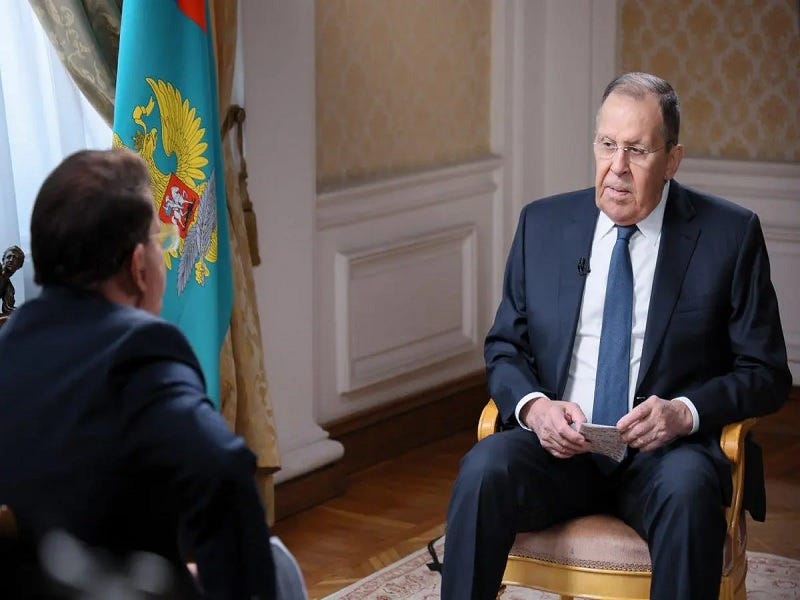
Russian Foreign Minister Sergey Lavrov’s recent interview with RBC was more than just the standard fare since he shared some interesting tidbits about his country’s policies therein. The first such one concerned Russia’s unequal membership in the G8 whereby “the most sensitive matters concerning the governance of the international monetary, financial, and trade system were discussed by the G7” without Russia’s input “by and large”. He then warned about “a possible crisis of overproduction”.
In his words, this is “owing to what the West has done to its own economies, there may be nowhere to sell everything China produces. But that is a practical matter, and it will be resolved.” Lavrov’s next interesting tidbit hinted that “the certain elements of compromise” that Putin and Trump agreed to at Anchorage had to do with Russia agreeing not to militarily pursue its claims to the entirety of Zaporozhye and Kherson Regions if Ukraine was coerced by the US into withdrawing from Donbass.
This reading is based on Lavrov relating that “[Trump] said that, essentially, only one difficult issue remained. I am referring to what everyone knows by now – the part of the Donetsk People’s Republic that is still under the control of the Ukrainian armed forces.” It stands to reason that the US didn’t agree to coerce Ukraine into withdrawing from Zaporozhye and Kherson Regions but declined to coerce it into withdrawing from Donbass. The abovementioned speculative quid pro quo might thus be credible.
Next, Lavrov shared his view that the UK “has never had permanent allies. The United States is no exception. They have always looked somewhat down their noses at those Anglo-Saxons who established their own state across the Atlantic.” He then unexpectedly praised the Lend-Lease program, declaring that “Many historians write that they played an almost decisive role in enabling us to hold out during the first year, up to the Battle of Moscow.” Most Russian officials, however, tend to downplay its importance.
Lavrov then segued into talking about Zelensky, quipping that he’s “outmaneuvering everyone” and “calling the shots for everyone”, even ignoring the “instructions” from the US to crack down on corruption. As for the Ukrainian Conflict, “We have never experienced anything like this in our history” because “the collective West’s front against us a universal one”, and “the only people in the trenches alongside us were North Korean servicemen. Everyone else is on the other side.”
Drawing to a close, Lavrov said that “we do not want a fee to be introduced (for passage through the Strait of Hormuz) either, but that is a matter for further discussions.” He also noted that the division of the world into American- and Chinese-led AI blocs is due to the US’ zero-sum demands of its partners. Finally, he admitted that “perhaps” “our ‘soft power’ is too soft, and it ought to be more assertive”, but he said that Russia never learned how to “orchestrate coups” like the West has.
In sum, the most interesting tidbits that Lavrov shared about Russian foreign policy arguably concern its expectation of a “crisis of overproduction” in China, his hint about what Russia compromised on at Anchorage, its opposition to Hormuz tolls, and his critique of Russian soft power. The Chinese and Iranian parts are the most important, and hopefully they’ll inspire members of the Alt-Media Community to candidly discuss them with a view towards better understanding these aspects of Russian policy.
«“the only people in the trenches alongside us were North Korean servicemen. Everyone else is on the other side.”»
Interesting comment on chinese policy.
«Lavrov’s next interesting tidbit hinted that “the certain elements of compromise” that Putin and Trump agreed to at Anchorage"»
My understanding of the Anchorage situation is quite different:
* Putin said that he had the list of 10 points in the Witkoff-Kushner proposal, and point by point he asked them and Trump if that was what they proposed, they replied yes, and then he told them he agreed, on each point.
PS: That was reported by Lavrov himself and that the "yes" was replied by Witkoff alone (Trump was present).
* Later Witkoff declared publicly some days later that at that meeting *Trump* had not agreed to any of the 10 points his representatives had made and confirmed they had made.
PS: That was not Witkoff but Rubio (Rubio was present in Anchorage too).
Putin did not have an "understanding" but a "misunderstanding" at Anchorage: he misunderstood that when some shysters make a proposal they also agree to it implicitly. But the USA did not agree to their own proposals, verbally, or by shaking hands, or in writing as an MOU never mind a treaty, and even when the USA government agree one has to remember the saying "as worthless as indian treaty". The USA government is particularly keen only on who has the most cards moment by moment, not what is written down.
So as far as the USA government are concerned the RF government is bound by the 10 points because they agreed to them, the the USA government is not bound by the 10 points because they proposed them but never agreed to them.
Putin speech of 2022-02-24: “Of course, practice, international relations and the rules regulating them had to take into account the changes that took place in the world and in the balance of forces. However, this should have been done professionally, smoothly, patiently, and with due regard and respect for the interests of all states and one’s own responsibility.”