

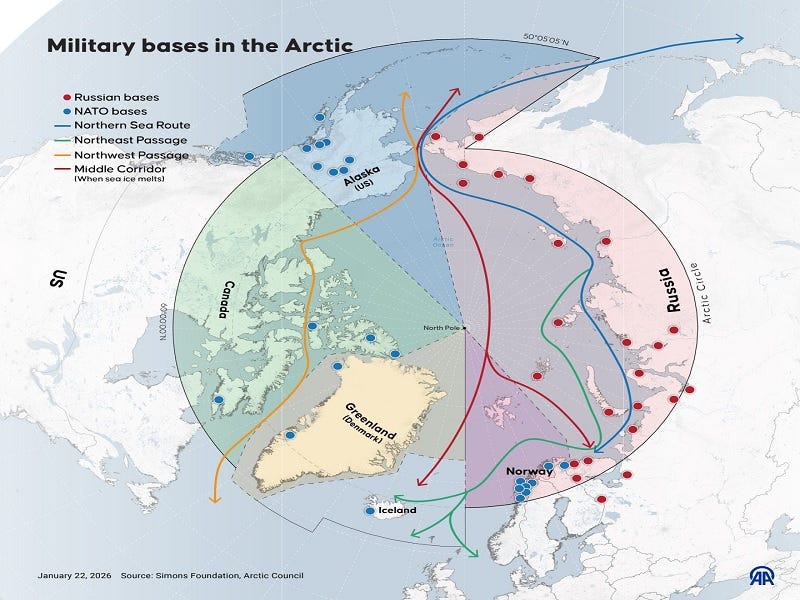
The military-technical developments there aim to greatly mitigate Russia’s nuclear second-strike capabilities via the Golden Dome in parallel with posing an unprecedented fifth-generation aerial threat via the F-35As that’ll outmatch Russia’s Su-57s by 10:1 without the US and 35:1 if it’s included.
RT reviewed the 2026 Russian Military Yearbook, which is sponsored by the state arms company and meant only for senior members of the national security apparatus. Their article can be read in full here, but the present piece will only focus on the part about “The Very Cold War”. This is in reference to escalating NATO-Russian tensions in the Arctic. The Yearbook details NATO’s large-scale military drills in the Arctic, its allies’ arms build-ups, and their deep displeasure with Russia’s Northern Sea Route.
Most alarmingly, the Yearbook mentioned that Finland plans to acquire 64 F-35As while Canada will receive 88 of them. It was separately reported that Norway already has 52 F-35As, which is more than double Russia’s estimated 20 or so Su-57s, its fifth-generation analogue. Sweden doesn’t yet have any fifth-generation fighters, but those other three Arctic states will have over 10x as many as Russia does. If the US’ over 500 F-35As are included, then Russia’s fifth-generation fighters will be outmatched by 35:1.
These statistics on their own show that the US is actively implementing its 2021 strategic plan for “Regaining Arctic Dominance” that was cited in the Yearbook, the latter of which also detailed some of NATO’s new radar, drone, ship, icebreaker, missile, and other military-technical plans. They altogether lend credence to one of the cited Russian experts who warned that “Washington never abandoned the thought of redrawing borders in that area.” Here are five background briefings on this new front:
* 14 January: “Greenland Is The Crown Jewel Of ‘Fortress America’”
* 21 January: “The US’ Acquisition Of Greenland Could Lead To A Deal Over Canada’s Arctic Islands”
* 21 May: “Finland Is On Track To Become One Of Russia’s Most Intractable Foes”
* 6 September: “The Historical Russian-Swedish Rivalry Is About To Be Revived Later This Fall”
* 15 September: “Norway’s Military Build-Up Against Russia Poses A Serious Threat To Arctic Security”
To summarize, Trump 2.0 is pursuing a three-pronged strategy against Russia: 1) build Golden Dome missile defense infrastructure in the Arctic to greatly mitigate Russia’s nuclear second-strike capabilities; 2) arm Canada and the Viking Bloc (Denmark, Norway, Sweden, and Finland) to threaten Russia; and then 3) likely push Russia’s limits along the Northern Sea Route for the purpose of provoking a crisis that would then render this corridor dangerous and thus greatly reduce its use at minimum.
The pressure that the US is placing upon Russia along the Arctic front via these means complements that which it’s also placing through Polish-led efforts in Central & Eastern Europe and Japanese-led ones in Northeast Asia. All of these fronts consist entirely of US mutual defense allies, but the Turkish-led one along Russia’s entire southern periphery doesn’t, yet a hypothetical special operation there (such as against Azerbaijan) might be deterred by the possibility of the US responding via the other fronts.
Simply put, a “cordon sanitaire” has been assembled around Russia, and this containment noose is being tightened the most by the military-technical developments along the Arctic front than anywhere else. Up till recently, this was the quietest front of the four, but that just shows that its members were moving silently to avoid attracting attention from Russia. The latest Yearbook proves that the Kremlin had been monitoring them all along and is thus planning its response, however, so this front will likely heat up.
1) The F35A numbers will have to be adjusted by taking into account Russia's air defenses, more than capable to contain the on-paper superiority.
2) The Arctic environment should be organized Iran-style: fully underground, in beton and steel, whenever possible. Decoys may play an important role here.
3) Obviously the protection of the iceberg fleet is essential
4) The potential commercial damage is real and cannot be mitigated. Russia's idea of inviting her partners to participate in the exploitation of their Arctic territory is very good and might offer some commercial relief
5) If I were asked, I would recommend that all commercial and scientific vessels should navigate escorted by the Russian Navy, which should be prepared to shoot to kill at the first sight.
6) On the rest of it, one has to take into account if the NATO countries have or will have the necessary resources to create and maintain this superiority. Full of debt beyond their eyes, poor in resources, with a population in continuous effervescence, these countries are unlikely to pose a serious threat to Russia, as I see the economic situation in the EU and the UK that degrades almost on a daily base. Norway is by far the more capable to be a real threat, and I believe Mr. Karaganov will have some good advice on how to deal with her when it comes to it. The US will not move a finger for any of these pawns. They will always have the alternative to negotiate with the Russians.
The whole thing with ‘Golden Dome’ and all those F-35As sounds very romantic but the ultimate reality is still MAD and hypersonic missiles and submarines delivering first and second strikes never meeting an F-35A in the sky. As far as Golden Dome is concerned it is a giant task that requires endless new inventions and technological achievements. An actual solution can be most likely huge numbers of space based satellites with laser weapons, something that is nonexistent at this time. The reality is that it takes years to refill stock with top end missiles after the Ukraine, Iran conflicts and these conflicts are still active. I do not see the high tech capacity present in the US to produce Golden Dome or even a Silver Dome within a few years, maybe not even in five or more years.