

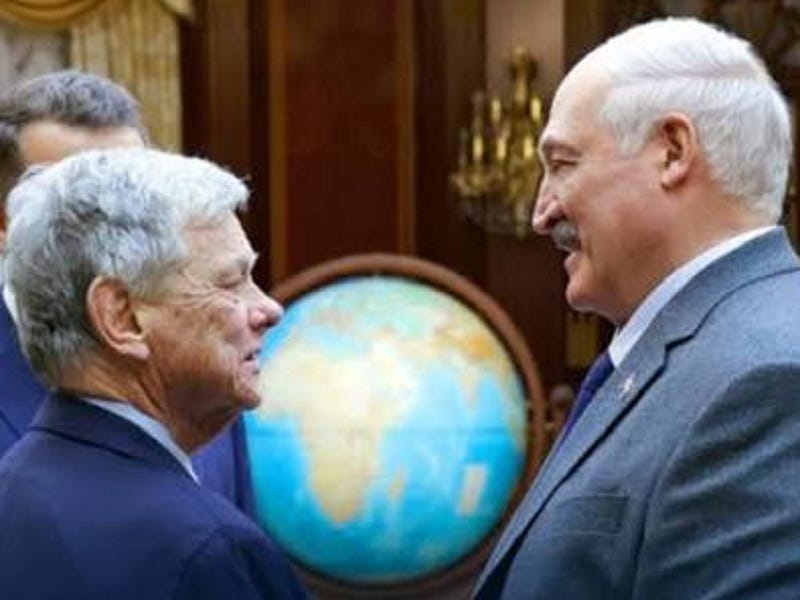
The Atlantic cited his Special Envoy to Belarus to report that he’s planning to offer Putin sanctions relief, which could take the form of big-ticket resource-related deals, in exchange for releasing so-called “political prisoners” following the arrangement that he recently reached with Lukashenko.
The Atlantic reported that Trump authorized his Special Envoy to Belarus John Coale to convince Putin to release so-called “political prisoners” in exchange for sanctions relief following the successful arrangement that he reached with Belarusian President Alexander Lukashenko. According to them, the massive Belarusian-US potash deal that Trump 2.0 is negotiating could be followed by similarly massive deals with Russia, perhaps along the lines of what The New Yorker reported in mid-September.
They cited a classified report from an unnamed European spy service to inform their audience that “Trump and people around him” are considering “reopening the Nord Stream 2 pipeline under American control, resuming ExxonMobil’s operations in Sakhalin, and drilling for oil in the Sea of Okhotsk. According to the report, there was discussion of unfreezing Russian assets that are held under American sanctions.” These proposals align with the resource-centric strategic partnership that they’re negotiating.
As a reminder, Putin declared in early 2025 at the start of Russia’s talks with the US that its companies “will make a decent profit” in such a scenario, which was elaborated on here and here in December of last year. In brief, they argue that Putin’s openness to such a deal is predicated in part on his desire to alleviate Russia’s growing dependence on China, while Trump’s is predicated in part on the same as well as his interest in denying China access to more Russian resources through US investments in its deposits.
Circling back to The Atlantic’s report, it claims that Trump authorized Coale to explore replicating his Belarusian dealmaking with Russia “a few months ago”, which coincides with his decision to “escalate to de-escalate” against Russia through a Ukrainian-led (and interestingly French-backed) “war of attrition”. He was therefore hedging his bet that Ukraine’s spree of drone strikes over the summer, which also targeted civilian infrastructure, would coerce Putin into agreeing to a ceasefire without preconditions.
Zelensky’s 40-day influence operation backfired badly by prompting Putin to mildly “escalate to de-escalate” in kind through more systematic strikes against all manner of Ukrainian infrastructure, which raises the odds of a Russian breakthrough across the front sometime over the winter. Likewise, these military-strategic dynamics raise the odds of a Ukrainian false flag in the EU (possibly Poland?), which could be carried out to manipulate the bloc into war with Russia out of desperation to save Ukraine.
Despite Poland’s ruling liberal coalition fearmongering about a Russian attack, whispers of Trump pursuing a Belarusian-like deal with it and awareness of Ukraine’s wintertime woes might have pushed them into initiating their rapprochement with Belarus so as not to fall too far behind events. The US might also have advised them to do this. So long as it’s not offset by a false flag, then this breakthrough could become part of a grand deal with Russia for shaping the post-war European security architecture.
A single big-ticket (probably resource-related) US deal with Russia would likely be enough to effect a major change in European policy towards Russia following the Polish precedent towards its ally Belarus for the same conjectured reason of not wanting to fall too far behind events. With this expectation in mind, Putin might even offer very generous terms to Trump, which would displease his supporters but could be what’s needed to bring about his long-sought diplomatic end to the Ukrainian Conflict.
I am seriously concerned about the basic logic of the deal you described here Andrew. We are talking about the abandonment of two decades of hard labor and endless murders to pursue the goal of Russia’s subjugation by US/NATO. They cannot walk away from that plan for a few hundred billion dollars and the release of a few people. The Deep State will not allow that and Trump is surely not the final decision maker here. On the other hand Putin is not in a position where he can walk away from this conflict without full security guarantees and these guarantees cannot be expressed with words on a piece of paper written with Trump’s ballpoint pen. The whole thing just does not add up. Even if we assume that the US feels trapped by losing the Iran and Ukraine conflicts, both at the same time, the whole thing is out of sync. The deal sounds logical but the people who make the final decision on the US side simply don’t do logic. They think in terms of bloodbaths and destruction, these are the only things on their minds. They need to be properly cornered and we are not there yet.
" The Atlantic reported that Trump authorized his Special Envoy to Belarus John Coale to convince Putin to release so-called “political prisoners” in exchange for sanctions relief following the successful arrangement that he reached with Belarusian President Alexander Lukashenko"
Every color revolution, is always preceded by the release of "political" prisoners by the side the US plans to take out in the future. So go ahead Putin:
Release the prisoners.
Allow foreign ownership of your media sources.
Allow foreign "election" monitors.
Allow pre-election "polling" by foreign news.
Allow "peaceful" protests.
Play the games of "democracy", what could go wrong ?