

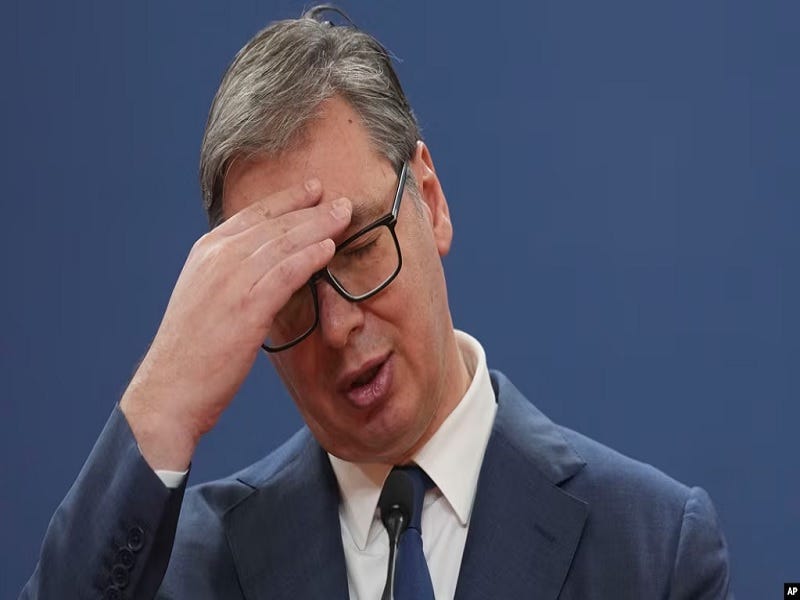
The toxic gaslighting that he and his media surrogates carried out combined with his refusal to groom a successor after over a decade in power to turn the majority against him.
Serbian President Aleksandar Vucic conceded defeat in late October’s snap elections after over a decade in power in various roles but blamed the EU and the US’ “deep state” for engineering the outcome. While it’s true that some members of the opposition are pro-Western and tied to foreign-funded “NGOs”, others are patriotic and Russian-friendly. Vucic also clinched a military logistics pact with NATO in 2016, purchased French warplanes, and armed Ukraine, so the West had no reason to remove him.
To be sure, he could have done more of the West’s bidding by formally recognizing Kosovo and sanctioning Russia, but the foreign policy concessions that he already made in part due to Serbia’s difficult geopolitical position were arguably enough for him to remain in their good graces. Be that as it may, one of Vucic’s two cardinal sins was the toxic gaslighting that he and his media surrogates engaged in, which portrayed him as a multipolar visionary devoutly allied with Russia in opposition to the West.
The patriotic and Russian-friendly segment of the opposition knew that was false but were viciously “canceled” for sharing the earlier-mentioned facts debunking this lie, while the pro-Western faction (that’s partly tied to foreign-funded “NGOs”) fell for it, which further radicalized them. With time, both polar opposite members of the opposition made common cause to democratically depose Vucic, but he duped Russia’s Foreign Intelligence Service into thinking that he was targeted by a Color Revolution.
The groupthink and echo chambers brought about by the Russian bureaucracy’s broken feedback loops, which were identified here as one of the country’s top three strategic challenges, made that possible. Nevertheless, Kremlin spokesman Dmitry Peskov expressed cautious optimism after the elections that bilateral ties will remain on track, the expectation of which is plausible given the opposition’s general worldview and especially after one of its representatives told RT Balkan that they won’t sanction Russia.
Vucic had fearmongered that they would, so their denial is significant, particularly given the fact that one of their representatives did so on the regional branch of Russia’s publicly financed global media flagship. It of course remains to be seen whether they’ll keep their word, and the pro-Western faction within the opposition could potentially subvert the Russian-friendly one’s plans, but it’s also premature to conclude that the worst-case scenario for Russian-Serbian relations will inevitably transpire.
In any case, speculation about the future of Serbian foreign policy is the direct result of Vucic’s downfall, which is due to him refusing to groom a successor for facilitating a phased leadership transition. Remaining in power for so long will inevitably turn a growing percentage of the population against the incumbent, especially the youth, yet Vucic evidently expected that he could indefinitely divide-and-rule both polar opposite halves of the opposition. That was his second and final cardinal sin.
Altogether, the toxic gaslighting that he and his media surrogates carried out combined with his refusal to groom a successor after over a decade in power to turn the majority against him, thus making Serbia’s latest elections the genuine reflection of the popular will and not a Color Revolution. As was earlier stated, some members of the opposition are pro-Western and tied to foreign-funded “NGOs”, but Vucic lost the election fair and square. Clinging to the Color Revolution narrative is therefore self-discrediting.
Hi Andrew,
Thank you as always for an informative article. I hope you will allow me to disagree with some of the things you say and that you will be open as always to a different take on things (I acknowledge I am no geopolitical expert here).
1) There is undeniable proof that the SL is US-funded. You yourself acknowledge that some of them are tied to US-funded NGOs. Just because the movement contains some well-meaning patriotic and Russian-friendly opposition does not mean this is not a colour-revolution. All other colour-revolutions (Egypt, Tunisia, Ukraine, etc...) contained well-intentioned factions that were duped throughout.
2) You acknowledge that Vucic could have done more for the West. That on its own could be reason enough to target him through a colour revolution, and to bring someone who would do everything the West demands.
3) You argue that Vucic engaged in toxic gaslighting and presented himself as a multipolar guru. Even if this is true, it does not mean this could not have been a US-funded colour revolution.
4) Vucic duped Russia’s Foreign Intelligence Service into thinking that he was targeted by a Color Revolution. The SL movement was US-funded; this funding was concealed, and instead the movement was presented as a grassroot, leaderless, decentralised movement with no money, which is a hallmark of colour-revolutions.
5) Russia expressed cautious optimism after the elections that bilateral ties will remain on track. This again does not mean that this could not have been a colour-revolution.
6) Vucic gaslighting the public and refusing to groom a successor does not mean this could not have been a colour revolution.
7) And finally, you calling lily357 a "braindead peasant". I hope you will forgive me for saying this but you are better than this. Lily is a serious commentator. She is not a Serbian bot, she is not a Vucic boot licker. She is a concerned citizen who is worried sick about her country as she should be.
Thanks again for allowing me to present a different opinion and for being so open to it.
I'm sure there were local reasons why the Serbs were tired of Vucic, but the student list WAS ultimately funded by the CIA. Russian Intelligence is right about that. There are American agents in this new government; I promise you that.