
Eastern Mediterranean Geopolitics Are Becoming More Complex

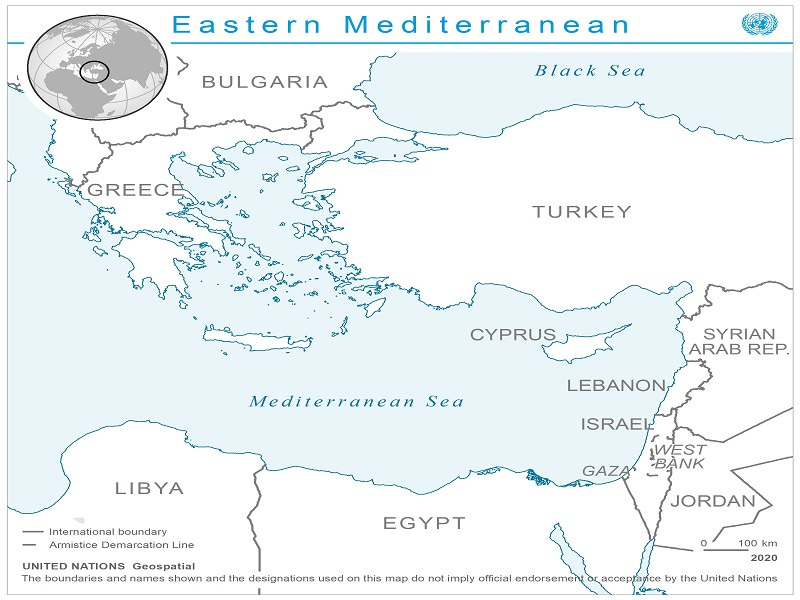
Tensions are growing between Turkiye-Pakistan and Israel-Cyprus-Greece.
Stability in the Eastern Mediterranean can no longer be taken for granted as a result of three recent developments: 1) the growing Turkish-Israeli rivalry in post-Assad Syria; 2) Israel’s reported plans to establish a rapid response force with Cyprus and Greece; and 3) Turkish ally Pakistan’s new military ties with Eastern Libya’s General Khalifa Haftar. The aforesaid are unfolding amidst Israel’s plans for an underwater EastMed gas pipeline to Greece and Turkiye’s maritime claims that cut right across its route.
The reported rapid response force could accordingly be assembled to defend the EastMed if construction on it were to begin while Pakistan might establish a military presence in Eastern Libya under the cover of training Haftar’s forces for complementing Turkiye’s in Western Libya so as to help Ankara counter this. Unaware observers should review this article here to learn more about the rapprochement between Turkiye and Haftar, previously enemies, which advances the former’s abovementioned maritime claims.
The Turkish-Pakistani Tandem (TPT) might not directly clash with Israel over the EastMed, at least not at first, since it’s much more likely that Turkiye would initially pressure it in Syria while Pakistan stirs trouble on its behalf at sea (perhaps with drones) through its potential military presence in Eastern Libya. The purpose would be to keep tensions manageable and “plausibly deniable”. That would be difficult to do if they targeted NATO member Greece, however, which could backfire by rallying the bloc around it.
For that reason, TPT would probably employ low-level and “plausibly deniable” hybrid provocations against Israel in the first stage, though Israel would be expected to call them out on this if it happens. It’s not possible to accurately forecast what might follow but it’s sufficient to predict that Israel likely wouldn’t back down since it rarely does so under military pressure. A conventional escalation might therefore be in the cards and that could in turn set the entire region aflame if it spirals out of control.
Turkiye’s interest in involving Pakistan in this dispute wouldn’t just be to diffuse responsibility for any escalation over its maritime claims but to have the support of the only Muslim nuclear power in order to deter Israel from responding in a way that risks a war between them. For its part, Pakistan would probably be happy to saber-rattle against Israel since this would play well domestically, but it understandably wouldn’t want Israel to force its hand into fighting a conventional war or backing down.
Any serious escalation between TPT and Israel would assuredly lead to an American diplomatic intervention given that all three are its close partners. Which side the US would support, however, remains unclear. While Israel is one of its most special partners, the EastMed pipeline could challenge the US’ newfound energy hegemony over the EU, so the argument can be made that it might prefer to impose a compromise whereby Israel supplies Turkiye with gas just like it’s poised to supply Egypt.
If Syria joins the Abraham Accords, then a pipeline could be built across its territory from Israel to Turkiye, while Lebanon could be involved as well if it too signs onto the accords. Even without that happening, an underwater pipeline could connect Israel’s offshore gas fields with Turkiye, which would strengthen their complex interdependence for reducing the risk of conflict. That would be the best-case scenario from the US’ perspective for resolving Turkish-Israeli tensions in the Eastern Mediterranean.
One quibble about turkey and one implication for Pakistan. The turks are trying to "veto" a lawful commercial infrastructure project, using ridiculous maritime claims for their EEZ (squiggly lines drawn laterally or through others waters). HOWEVER, even if this subsea infrastructure were transiting through their EEZ, they have no legal right to stop it- it would be governed by conventions on sub sea infrastructure that only require national consent when transiting national waters (like Nordatream near Bornholm Island). A veto here would be an illegal violation (nothing new to the turks,.who are now producing maps with Allepo, Mosul, Armenia and Cyprus colored red as part of a greater Turkey).
As for Pakistan, they have hundreds of thousands of "guest workers" (most trafficed throgh Turkey and illegal) in Greece and the rest of Europe, sending back needed remittances and easily replaced by Indians or South Americans. An easy pressure point.
There is zero trust between Israel and current Turkey. Collaboration might have happened 40 years ago. But today? With primary support for Hamas coming out of Turkey (as well as Qatar and Iran)? This applies both to the gas pipeline and to Lybia. In Lybia, it looks like Israel is quietly supporting the Egyptian-Russian side against the Turkish side too. Egypt also hasn't forgotten that Turkey was supporting Egyptian Muslim Brotherhood, Mursi et al. If Turkey further allies with Pakistan, India will move to the anti-Turkish side too.