
Trump’s Latest Tariffs Against Several NATO Allies Could Have Far-Reaching Consequences

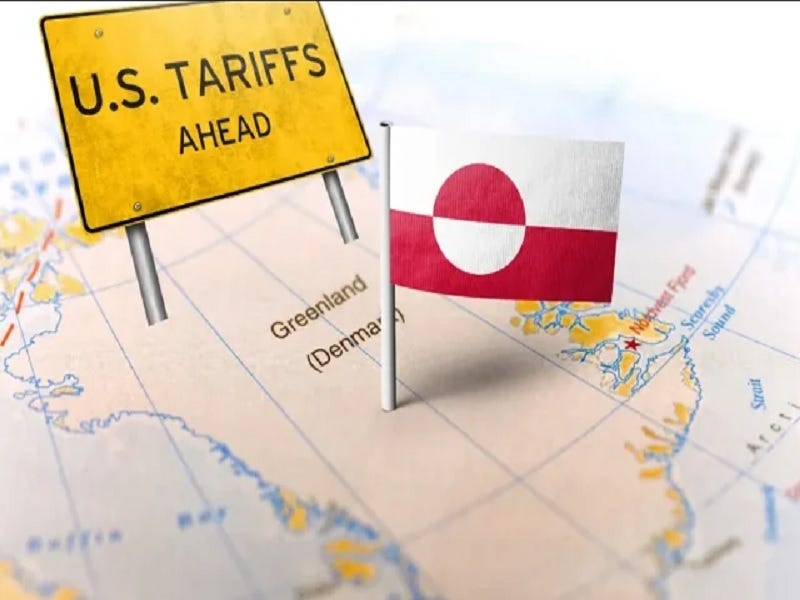
The US might abandon its new interest in backing radical “security guarantees” for Ukraine due to worsening ties with Western Europe; increasingly Polish-led Central & Eastern Europe could replace Western Europe’s strategic importance for the US; and intra-EU rifts might accordingly widen.
Trump announced that the US will impose 10% additional tariffs on those NATO allies next month who symbolically dispatched a handful of military units to Greenland ahead of upcoming multilateral drills there with Denmark before scaling this to 25% on 1 June. The affected NATO allies are Denmark, the UK, France, the Netherlands, Germany, Norway, Sweden, and Finland. This announcement comes right before next week’s Davos Summit while the second deadline comes right before the next NATO Summit.
Trump therefore expects the issue, as well as the scenario of a new US-EU trade war that could follow the bloc’s lawmakers putting approval of last summer’s deal on hold in response to his new tariffs, to dominate discussions next week and ideally lead to a deal around the time of the next NATO Summit. About that, he declared in his announcement that the US wants to purchase Greenland from Denmark, but he also importantly didn’t exclude using military means if Copenhagen remains recalcitrant.
Given the sorry state of the EU economy in general due in no small part to its compliance with US sanctions that resulted in cutting off low-cost energy imports from Russia, it’s unlikely that the EU could wage a protracted trade war with the US, let alone win one. Likewise, while The Economist speculated that the affected NATO allies like Germany might kick the US out of its bases there, neighboring Poland could simply host them instead like it’s been practically begging to do for years already.
To channel what Trump infamously told Zelensky during last year’s infamous White House meeting, Europe therefore has no cards, which raises the question of why it would provoke Trump into what might soon become a trade war in which its affected NATO allies are doomed to defeat. The most realistic reason is that they wanted to virtue signal their commitment to the “rules-based order” that Trump shredded with Maduro’s capture during the US’ astoundingly successful “special military operation”.
Given their junior partner status vis-à-vis the US, which was already enshrined in the nature of their relations upon them complying with its anti-Russian sanctions but was radically reinforced amidst the rapid restoration of US power under Trump 2.0, they should have bandwagoned around it. After all, their relations with Russia are already ruined and ties with China aren’t anywhere near as close as they’d need to be to rely on them for balancing the US, so bandwagoning would have been the best option.
Instead of bandwagoning or balancing, the affected NATO allies (which consider themselves to be champions of the now-defunct “rules-based order” that was destroyed by the US’ own hand after it no longer served its interests) tried to militarily challenge it in a symbolic way, which provoked Trump. Knowing how he views the world, which isn’t a secret since he’s open about his opinions, he arguably perceived that as both unacceptable and pathetic. He now wants to humiliate those who opposed him.
This includes the UK’s King Charles, French President Emmanuel Macron, and Finnish Prime Minister Alexander Stubb, all of whom he hitherto thought of as friends and whose countries play key roles in containing Russia. If the US’ ties with those three countries deteriorate in parallel with Trump’s personal ones with their leaders, then the US might stop flirting with extending support to NATO allies’ troops in Ukraine, which would remove the newly dangerous ambiguity over its approach towards this issue.
Furthermore, any worsening of the US’ ties with Western Europe would please Poland, which envisages leading Central & Eastern Europe (CEE) and has received tacit US support in pursuit of this grand strategic goal. Likewise, the intra-EU tensions that might erupt as a result of the bloc’s lawmakers putting approval of last summer’s trade deal with the US on hold could help popularize Polish President Karol Nawrocki’s plans for reforming the EU, which regional countries might begin to collectively champion.
To review, the consequences that might follow Trump’s latest tariffs against several NATO allies are: the US abandoning its new interest in backing radical “security guarantees” for Ukraine due to worsening ties between the US and Western Europe; the acceleration of the US’ strategic reprioritization of increasingly Polish-led CEE over Western Europe; and a Polish-led widening of the intra-EU rift between Western and CEE over respectively centralizing the bloc or reforming it to preserve members’ sovereignty.
All of these are plausible but only in the scenario of protracted problems between the US and the affected NATO allies, which might not come to pass if they re-evaluate their strategic positions, realize that they have no cards, and therefore promptly abandon their opposition to Greenland’s purchase. If they stubbornly double down for ideological reasons, however, then the consequences would be far-reaching and altogether make them even more irrelevant in global affairs than they already are.
Thanks - another very perceptive analysis
You’d have to ask yourself wtf is going on in the heads of Starmer, Merz and Macron (not to mention Carney who’s promising to invoke Article 5) that they would send a multinational ‘deterrent’ force of 15 troops to Greenland.
What was the message here?
Is there some sort of Cunning Plan in the offing?
If so I wish I knew what it is.
I politely contend with the author’s premise that the EU lacks leverage over Trump. Such a premise might hold in a world driven by rationality, but power relations, not least in politics, often function otherwise. The fact is that the EU has proven itself a master at turning its weakness into an asset, particularly in exploiting Trump. The “lopsided” U.S.–EU trade deal, as a quid pro quo, was more of a strategic win for Ukraine and Co. than for the U.S., for it solidified Trump’s commitment to NATO support for Ukraine, within unstated limits. Now Brussels is using Greenland and tariffs as pressure tools over Trump’s policy reversal on Ukraine (a shift driven in part by false flags and “deep-state” manipulation). Trump’s hands-off approach, by contrast, has given his EU “subordinates” the impression that he values NATO unity on Ukraine above all else, possibly incentivizing their efforts to act as the “tail wagging” Trump’s dog.
Trump could have leveraged U.S. preponderance to extract far more from his European vassals than he has to date, including sanctions on EU banking, along with reduced military-intelligence sharing or other cooperation, for their refusal to back a U.S.–Russia détente, U.S. priorities on drugs and migration, and so on. Trump not only refused to consider any of this, but also promised Ukraine military aid for rare earths in February (this was *before* the blowup with Zelensky, mind you): https://www.youtube.com/watch?v=AT_EmmysebY. [7:45: “With Ukraine and this minerals deal, what does Ukraine get in return, Mr. President?” 7:51 (Trump): “Uh, $350 billion, and lots of equipment, military equipment, and the right to fight on.”] Trump was always torn between sympathy for Ukraine and pragmatism toward Russia, a duality that his “frenemies” took advantage of. And Trump never pushed Europe toward a Ukraine peace.
This likely leads Brussels to conclude that Greenland is one more valve that it can use to force Trump into a “compromise” that further estranges him from Russia and increases NATO entanglement in Ukraine. In this case, somewhat ironically, the EU is playing a bigger role in threatening the end of NATO than Trump is. Its willingness to escalate on Greenland precipitated Trump and his advisers’ murmurings about military force or a “choice” between U.S. and NATO. At any rate, the EU probably calculates that it can exert pressure on Trump through most of his principal advisers, among them Rubio and Hegseth, who have been far more wedded to the conventional U.S./NATO setup than Trump has. Given past history, I expect that the EU will offer a “sweetheart” settlement that will cause Trump to back down, possibly a reconfiguration of the original U.S. plan for Greenland that now accommodates EU policy on Ukraine.