
Trusted Security Ties With Myanmar Are Indispensable To India’s National Interests

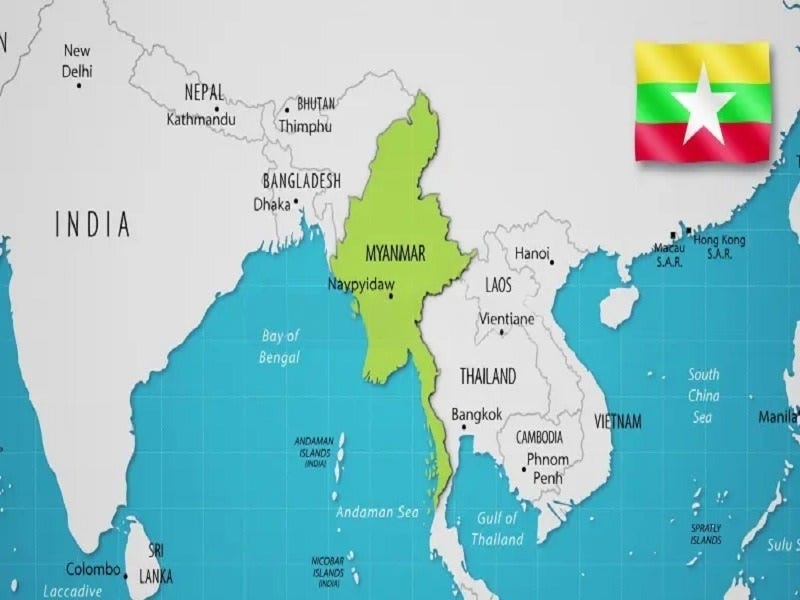
They’re the key to unlocking the full potential of Indian-ASEAN ties once the latest phase of Myanmar’s civil war finally ends and thus completing India’s rise as a globally significant Great Power.
Myanmarese President U Min Aung Hlaing paid his first official visit to India, during which time he “reiterated Myanmar’s assurance that its territory would not be permitted to be used against India’s security interests” according to his joint statement with Indian Prime Minister Narendra Modi. This advances India’s national interests in three ways, the first of which has to do with their cross-border conflict involving terrorist-designated ethno-separatists that was last in the news earlier this year.
“Ukrainian Mercenaries Were Caught Training Indian-Designated Terrorists In Drone Warfare” after returning from Myanmar. As a brief backgrounder, Myanmar has been embroiled in the latest phase of its civil war since early 2021, with this extremely complicated conflict stretching back to the immediate post-independence era to be the world’s longest ongoing one by far. Despite its best efforts, the Tatmadaw (Myanmarese military) lacks full control over its borders, which worsens India’s security.
While it’s unlikely that India will intervene on the Tatmadaw’s side to restore security on their shared border, it’s nonetheless reassuring to know that Myanmar obviously opposes the cross-border threats to India that the latest phase of its civil war have exacerbated. Moving along, the second way in which Aung Hlaing’s reaffirmation advances India’s national interests is due to what it implies about China, which India reportedly suspected in the past of having an spy base on one of its islands in the Bay of Bengal.
Contrary to the impression of casual observers, Sino-Myanmarese relations have always been rocky, with Myanmar only embracing China due to an absence of choice after being sanctioned by the West near the end of the Old Cold War and more recently during the start of its civil war’s latest phase in 2021. Being the junior partner due to their obvious asymmetries despite mutual rhetoric about equal relations, Myanmar might have felt compelled to offer such a facility to China in the past, if earlier reports are true.
Trump 2.0’s Neo-Reagan Doctrine doesn’t just seek to roll back Russian influence, but also Chinese, to which end his team has been considering a pragmatic shift vis-à-vis Myanmar from unofficially fighting the Tatmadaw through proxies to easing sanctions for access to rare earths. The US would want Myanmar to shutter the alleged Chinese spy facility in that event, which would also align with Indian interests. Once again, it’s unclear whether it ever existed, but it likely isn’t in use anymore if it did.
And finally, Aung Hlaing’s reaffirmation helps maintain the trust required for resuming cooperation on the Kaladan Multi-Modal Transit Transport project and the India-Myanmar-Thailand trilateral highway, which were also mentioned in their joint statement. Myanmar is India’s overland gateway to ASEAN so its importance in India’s grand strategy can’t be overexaggerated. The full implementation of these projects after the latest phase of the civil war ends will therefore strengthen Indian-ASEAN synergy.
India’s rise as a globally significant Great Power will remain incomplete so long as the aforesaid synergy continues to be disrupted by the latest phase of Myanmar’s civil war, but even then, it would still fall far short of its full potential without trusted security ties of the sort that Aung Hlaing just reaffirmed. Therefore, one of the steps in the direction of this grand strategic goal was just taken through his visit, with the next being much more difficult to take and concerns the resolution of his country’s conflict.
Myanmar is a srtong part of India. It needs to be taken seriously.