
Hungary Warned About Brussels’ Three Regime Change Plots In Central Europe

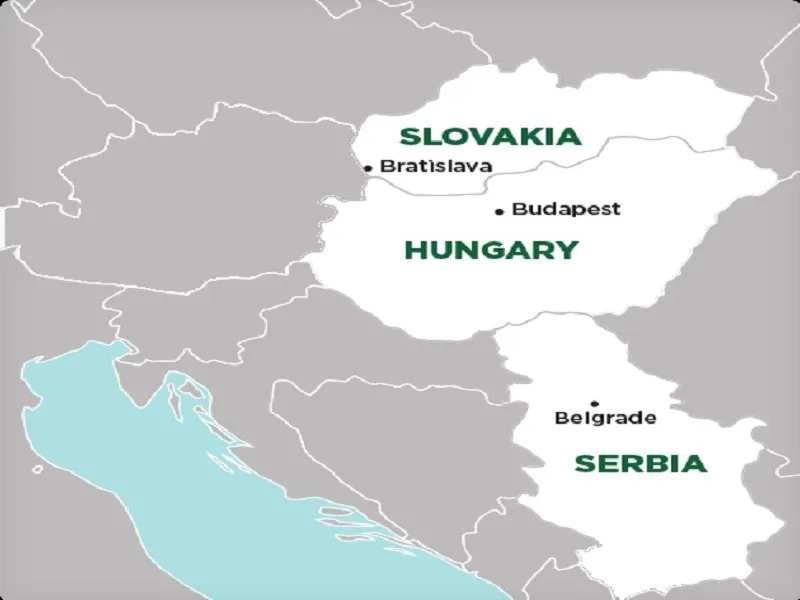
These are being advanced through a combination of information warfare and support for anti-government (Brussels-organized) “NGOs” (BONGOs).
Hungarian Foreign Minister Peter Szijjarto warned in a Facebook post last month after talks with his Slovak and Serbian counterparts that Brussels is plotting regime change against them. This comes after Russia’s Foreign Intelligence Service (SVR) reported that the EU and Ukraine are backing the Hungarian opposition ahead of next spring’s parliamentary elections. The larger context is that they’ve all defied EU pressure to cut ties with Russia and are considering the creation of a new regional integration platform.
From the EU’s hegemonic perspective, those three’s current governments do indeed pose “an increasingly serious obstacle to a ‘united Europe’” as SVR described Hungary as being vis-à-vis Brussels, with that country being the main one followed by Slovakia and then Serbia to a much lesser extent. Long-serving Prime Minister Viktor Orban is a populist-nationalist icon on the continent, while his Slovak counterpart Robert Fico only recently returned to office but immediately followed in Orban’s footsteps.
Serbian President Aleksandar Vucic is an altogether different story, however, since he presents himself as a populist-nationalist but in many ways behaves as a liberal-globalist. For instance, SVR recently accused his government of indirectly arming Ukraine, which followed its votes against Russia at the UNGA. He also claims that recurring protests against his rule are a Color Revolution, which Russia has thus far agreed with, yet there’s also no denying that some bonafide populist-nationalists fiercely oppose him.
That’s because of his aforesaid anti-Russian moves, his concessions to the NATO-occupied Autonomous Province of Kosovo and Metohija, and his obsequious attitude towards the EU. At the same time, he also hasn’t fully capitulated to all of the West’s demands either, ergo why some of its ruling liberal-globalists want to depose him. Therefore, while it’s dishonest to describe him as a populist-nationalist in the same vein as Orban or Fico, it’s still true that all three don’t fully tow the EU’s line on Russia.
Circling back to Szijjarto’s recent post after clarifying the situation with Vucic, the EU’s regime change plots against all three are being advanced through a combination of information warfare and support for anti-government (Brussels-organized) “NGOs” (BONGOs). The purpose is to turn voters against the ruling parties (or whichever presidential candidate they endorse like in Vucic’s case after he said that he won’t amend the constitution to run again) so that their leaders can later be “democratically” deposed.
Prior to the next elections as well as in the scenario that this plot fails, infowars and BONGO protests are weaponized to discredit these figures as the pretext for justifying more direct EU pressure against them and their countries. Regardless of whatever form this takes, the end goal of regime change remains the same. It’s simply unacceptable from the EU’s hegemonic perspective for them to oppose Brussels on such important issues as Russia even in non-member Serbia’s case since this undermines its authority.
Looking forward, all eyes will be on Hungary’s spring elections, which will be the first chance for the EU to “democratically depose” one of these three leaders unless Serbia holds early elections before then. In Serbia’s case, whoever Vucic endorses might take his pro-Western pivot to its conclusion, so it might not matter whether they or the opposition win. It’s more difficult to predict what’ll happen in Hungary’s case, however, but the ruling party’s loss would be a powerful blow to populist-nationalists in Europe.
The EU hates Orban. Yet, Hungary is cleaner and safer than Germany. Hungary focuses on families and not immigrants who won't work or on the LGBTQ community which represents less than 1 percent of the population. They hate Orban because he is doing more right than wrong.
Honestly though in 200 years some African kids will read about the Western civilization and how it ended because nobody had babies anymore, just like I read about the fall of the Romans and Greek in school. It started with endless wars, Ukraine and Gaza. That's if civilization will still exist in 200 years.
The Hungarian economy is weak but it has never been lot stronger either. The actual data released by government agencies is tainted just like it always was in the communist era. Nationalists are complaining about the well paid jobs, business opportunities going to a certain (((minority))) centered in the Budapest area. The realistic view of the economy comes from the birthrates as those have a tendency of never lying. For the whole country the rates are 1.4/women of childbearing age. The well considered opinion of demography calls this tragically low, well below the replacement level. If we add that the gypsy population has an at least 2.5 or maybe 3.0 childbirth rate and there are over a million gypsies in Hungary, obviously the Hungarians’ birthrate is even lower than 1.4 and that is a demographic collapse in the making.
Still, the likelihood that Peter Magyar and his EU financed Tisza Party can overcome the FIDESZ structure built by Orban is very low presently. Orban is operating with the promise of keeping the country out of the war in Ukraine. Peter Magyar cannot afford to do this as his paychecks would be cut off by Brussels immediately. If I was in Orban's place I would be very-very careful, thinking about the sad event that played out around PM Robert Fico of Slovakia.