
Is Germany Going Nuclear?

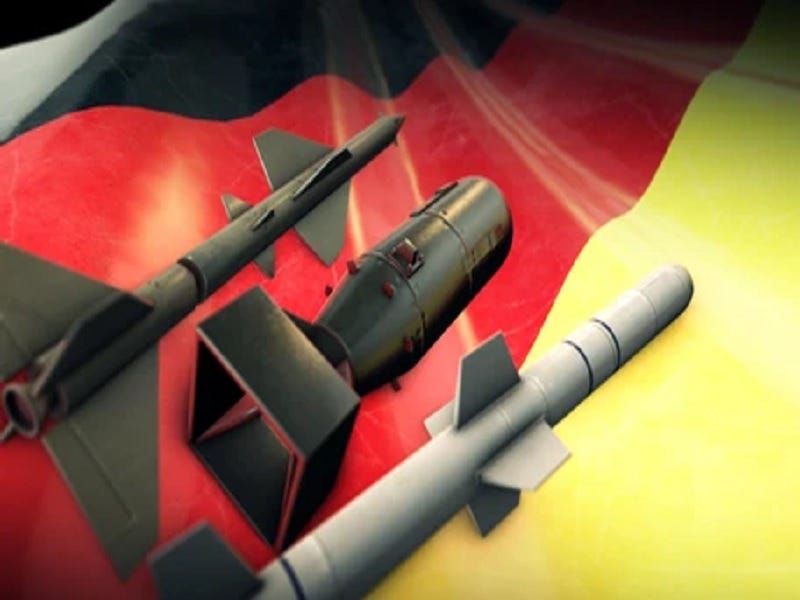
Russia’s Foreign Intelligence Service reported that it’s moving in this direction.
German Chancellor Friedrich Merz’s announcement in mid-July that his country will participate in a French nuclear drill for the first time later this year as part of the latter’s “forward deterrence” policy was followed a few days later by Russia’s Foreign Intelligence Service (SVR) claiming that it’s building nukes. They wrote that “the relevant ministries of one of the key NATO states are expressing concern about the active research and development work being carried out in Germany that has a nuclear weapons focus.”
Some of the universities involved allegedly “include the Karlsruhe Institute of Technology, the Ruhr University Bochum, the Ludwig Maximilian University of Munich, the RWTH Aachen University, and the Technical University of Berlin.” As for the companies, they concern “Rheinmetall AG, Diehl Stiftung GmbH, KNDS Group, and Umarex GmbH.” Moreover, “These [high-energy explosives and electronic detonation systems] are regularly tested at the German Army’s testing grounds”, according to SVR.
They concluded their report by writing that “NATO military experts believe Berlin is capable of independently producing the necessary fissile material within one to three months and constructing a working nuclear explosive device within a year, without conducting full-scale tests.” To be sure, it’s possible that SVR’s information is inaccurate as was the case with its several claims in recent years that the US is plotting to remove Zelensky, which have yet to unfold and were documented in this piece here.
That said, the US’ refusal to extend the New START with Russia raised the likelihood of a nuclear arms race, which could lead to Germany and other European countries like Poland developing nukes. It was assessed here that “So long as Germany is under someone’s nuclear umbrella and they have the political will to uphold their commitment, whether that’s the US, France, and/or the UK, then it’s unlikely that Russia would risk World War III by attacking Germany if it begins developing nukes.” That analysis stands.
Although Germany’s €800 billion remilitarization plans could see it replace the US as Russia’s top perceived adversary independently of whether it develops nukes due to posing a 1941-like threat, Putin recently rebuffed the hawks who want him to attack NATO, condemning such talk as a “provocation”. Russia’s latest Sarmat ICBM test was meant to deter nuclear provocations, such as those posed by France’s newly announced “forward deterrence” at the time, and latent German conventional threats.
It therefore follows that Putin wouldn’t flip-flop by seriously considering a first strike against a nuclearizing Germany since he sincerely believes that Russia’s Sarmats could make the scenario of a nuclear-armed Germany manageable. That’s a reasonable calculation, but it depends on his country’s nuclear triad remaining intact, which Ukraine has attacked several times already with Western backing. Former top spy Andrey Bezrukov warned that it could remain in their crosshairs for the coming decades.
Putting everything together, SVR’s report deserves to be taken seriously, including by Western officials and experts due to the significant changes that it could bring about for the European security architecture, which could further destabilize this increasingly unstable continent to uncertain ends. Even in the worst-case that Germany goes nuclear, nobody should doubt that Russia will ensure its national security, and any attempt to repeat the horrors of the Great Patriotic War would be the end of Germany.
For the German economy of today building a functional nuclear force would be easier than setting up an automobile factory for most nations. Regardless, Germany should be very cautious and considerate in this process.
Trust less in your judgment about the enemy's INTENTION; prepare for what the enemy's ABILITY can carry out. -- my paraphrasing of some better minds' words, but I forgot who said that. Yes, it is a little bit paranoid, but so are many things in the national security business.