
Which Western Security Guarantees For Ukraine Might Be Acceptable To Putin?

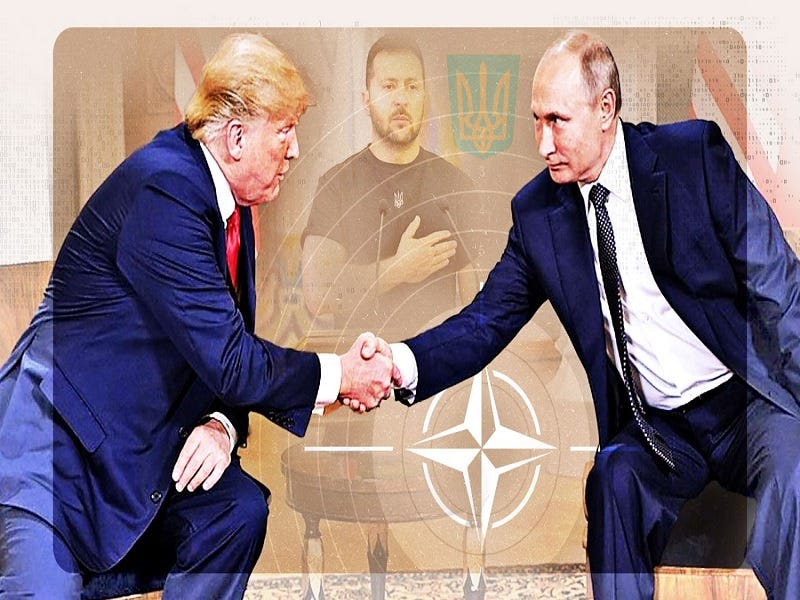
He might hypothetically agree that the resumption of NATO’s present support for Ukraine (arms, intelligence, logistics, etc.) in the event of another conflict wouldn’t cross Russia’s red lines but he’s unlikely to compromise on the issue of Western troops in Ukraine once the present conflict ends.
Steve Witkoff’s claim that Putin allegedly agreed to the US offering Ukraine “Article 5-like protection” during the Anchorage Summit, which Trump repeated during his White House Summit with Zelensky and a handful of European leaders, raises the question of what form this could hypothetically take if true. Assuming for the sake of analysis that he did indeed agree to this, it’s important to clarify exactly what Article 5 entails. For starters, it doesn’t obligate allies to dispatch troops if one of them is attacked.
Per the North Atlantic Treaty, each member only has to take “such action as it deems necessary”, which could include “the use of armed forces” but doesn’t have to. As was explained earlier this year here, “Ukraine has arguably enjoyed the benefits of this principle for the past three years despite not being a NATO member since it’s received everything other than troops from the alliance.” Arms, intelligence, logistical, and other forms of support have already been provided to Ukraine in the spirit of Article 5.
It might therefore be the case that Putin agreed that such “Article 5-like protection” could be resumed in the event of another conflict without crossing Russia’s red lines. Although Russia objects to Ukraine’s remilitarization after the present conflict ends, it’s possible that it could agree to this too as part of a grand compromise in exchange for some of its other goals being met as explained here. What Russia doesn’t agree to, however, is the dispatch of Western troops to Ukraine after the present conflict ends.
Foreign Ministry spokeswoman Maria Zakharova declared on the day of the White House Summit that “We reiterate our long-standing position of unequivocally rejecting any scenarios involving the deployment of NATO military contingents in Ukraine”. This position isn’t expected to change since one of the reasons behind the special operation is to stop NATO’s expansion inside Ukraine. Western boots on the ground there afterwards would therefore amount to the perceived failure of Russia’s primary goal.
This would especially be the case if they’re deployed along the Line of Contact, but their deployment west of the Dnieper in parallel with the creation of a demilitarized “Trans-Dnieper” region controlled by non-Western peacekeepers as proposed here could hypothetically be a compromise. That said, Russia would prefer for there to only be non-Western peacekeepers, if any at all. The deployment of foreign military forces, regardless of the country, could embolden Ukraine to stage false-flag provocations.
To summarize, in the order of the most hypothetically acceptable Western security guarantees to Ukraine to the least hypothetically acceptable from Russia’s perspective, these are: 1) the resumption of Western support for Ukraine only if another conflict erupts and without any peacekeepers at all; 2) continued Western support but with non-Western peacekeepers; and 3) continued Western support, Western troops west of the Dnieper, and non-Western troops in a demilitarized “Trans-Dnieper” region.
The scope of Ukraine’s demilitarization and the extent of Western security guarantees to it after the present conflict ends are of the utmost importance for Russia in order to prevent Ukraine from once again being weaponized as a launchpad for Western aggression. It’s therefore highly unlikely that Russia will compromise much on this issue, especially the scenario of Western troops in Ukraine. Russia might be more flexible on other issues, but on this one, it might prove unwavering.
I'm afraid Russia will have to live with hostile NATO and its friends closer to Russian borders than before SMO. Ukraine as a truly neutral, disarmed and politically dependent from Russia state is unlikely to materialize. Sweden and Finland, the new NATO members with a long northern border, need attention, too. A can of worms has been opened.
Any deployment of Western troops inside Ukraine will be an unacceptable slippery slope for Russia, exactly for the same reason why they decided to start the ‘Special Operation’. Once US/NATO is enabled to send in troops they will compromise whatever is left of Ukraine and use it as springboard for an everlasting war. There are a lot of indications showing that this is exactly what they have in mind. Just like in the decade before this conflict started, they are already doing the preparations for a next phase.
1, They are systematically preparing Moldova and Romania to be turned into the new proxy states. In both nations the EU is heavily involved in lawless acts to manipulate the governments and elections there. They are focusing on these two nations for their geographic positions and the fact that both of these countries are poor, underdeveloped and are saturated with corruption just like Ukraine. The political leadership once softened up can be bought by the pound. A color revolution is in the process in Serbia, very close to a full blown revolution to destabilize the government there. In Hungary a Mr. Peter Magyar is heavily financed and supported by Brussels to undermine the Orban government. Ukraine just stopped the oil deliveries from Russia to Hungary, economically undermining the stability of that nation while Hungary might stop pushing electricity toward Ukraine as an answer.
2, The whole of Western Europe is gearing up for heavy weapon production as we speak but it will take them some years to get there. The Sentinel-1 data photographed from space shows that a third of the major weapon manufacturing locations in the West are growing at accelerated rates. The ASAP program with 88 locations and $500 million investment is building roads to move heavy machinery to the locations. $1.5 billion is targeted for long range rockets and drones. Hungary is already setting up a factory to produce 1.1 million 155mm shells with the help of German Rheinmetall. The production is supposed to reach the 1.1 million shells next year but this will not necessarily happen. Supply and the necessary heavy machinery sounds difficult to all arrive on such short order. In Germany, Schrobenhausen a $5.6 billion dollar program is aiming to produce 1000 Patriot GEM-T missiles per year. In Norway the military industrial complex is also gearing up. Rheinmetall wants to take over an old VW factory for the assembly of Leopard tanks and heavy military vehicles at Osnabrück, Germany.
Western European nations are reshaping their industries with maximum speed with war on their feverish minds, incorporating sectors of nonmilitary productivity. They are hoping that Russia will watch this process silently and wait forever for the preparations to finish.