
Russia’s Setbacks Abroad Aren’t Due To The Special Operation

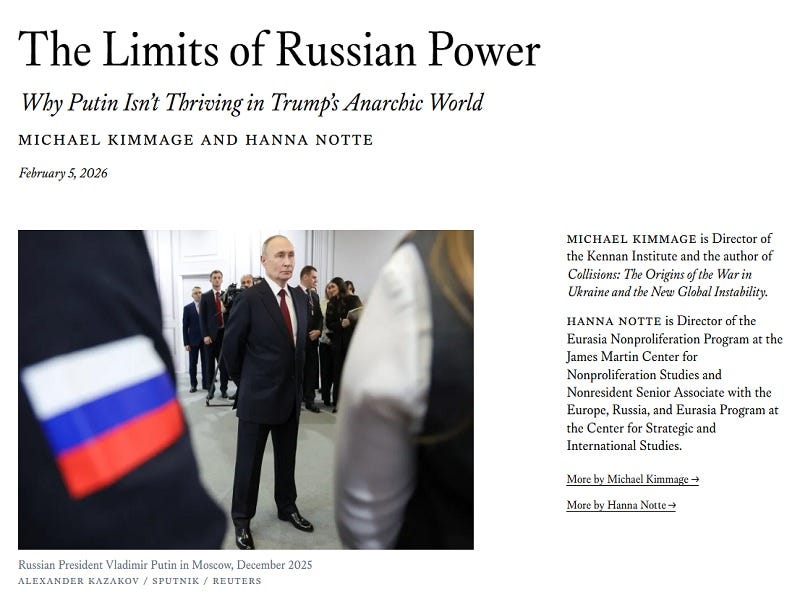
This popular narrative, which Foreign Affairs was one of the latest to push, is very misleading.
Foreign Affairs, the official magazine of the powerful Council on Foreign Relations that’s widely read among Western policy influencers and policymakers, recently published a piece about “The Limits of Russian Power”. The subtitle shows that it’s about “Why Putin Isn’t Thriving in Trump’s Anarchic World”. The narrative agenda is to portray the special operation as the catalyst of Russia’s supposedly irreversible decline by exaggerating its setbacks in Syria, Iran, Armenia-Azerbaijan, and Venezuela to that end.
The aforesaid setbacks, which many in Alt-Media dishonestly deny to this day, are then contrasted with the geostrategic status quo ante bellum for dramatic effect in order to maximally impress this narrative upon the reader. This preconditioning sets up the climax of fearmongering that Russia might risk World War III out of desperation to achieve some sort of victory in Ukraine “by striking Ukraine’s supply routes in eastern Europe or by attacking the U.S.-owned satellites that provide targeting information to Kyiv.”
This narrative might be convincing to some since it’s built upon the fact of Russia experiencing some setbacks over the past four years of its special operation, which Foreign Minister Sergey Lavrov alluded to in a recent interview, but their causes are misattributed and the consequence fearmongered about. They’re not due to the conflict but to the preexisting limits that had hitherto been underdiscussed such as Russia’s reasonable unwillingness to risk war with Turkiye, Israel, and the US over third countries.
Instead of typically cautious Putin inexplicably risking World War III by authorizing direct kinetic action against NATO despite already restraining himself after so many provocations worthy of such a response, however, he’ll likely continue what Lavrov’s friend Pepe Escobar coined the “snail offensive”. In parallel, far-reaching reforms might be planned for after the special operation ends to repair broken feedback loops within the military, intelligence, and diplomatic bureaucracies that perpetuated “wishful thinking”.
Even though Russia wasn’t ever going to risk war with Turkiye, Israel, and the US over Syria, Iran, and Armenia-Azerbaijan and Venezuela respectively, it might have been able to avert some of these setbacks had members of those institutions recognized strategic threats before they materialized. Instead, it looks like the same “wishful thinking” in which Putin cautioned his CIA analogue against indulging in summer 2022 remained a problem, thus explaining with cogency why Russia was caught flat-footed each time.
These systemic challenges to which attention was drawn during the special operation, which isn’t responsible for them since they far predate it, are reparable if there’s political will and proper oversight. Russia could then more effectively and flexibly adapt to them upon excising “wishful thinking” from the minds of its “deep state” members. Some future setbacks might also be averted while the policymaking basis would then be solidly established for sustainably restoring Russia’s lost influence in those regions.
Continued “wishful thinking” within Russia’s military, intelligence, and diplomatic bureaucracies, worsened by its “global media ecosystem’s” creation of alt-realities (“Potemkinism”) further tainting their already broken feedback loops, is responsible for its setbacks, not the special operation. Likewise, the consequence won’t be Putin attacking NATO out of desperation for some sort of victory in Ukraine, but him continuing the “snail offensive” and maybe planning far-reaching reforms after the conflict ends.
Russia’s problems are truly not rooted in Russian acts of the last decades. It is not their fault that they did not spend excessively to prepare for a major conflict, 20th century style. The fault is with those Neanderthals who actually dreamed up this conflict in D.C. and Brussels. Russia recognized the new realities of being a regional power and acted accordingly. Putin cannot be blamed for not possessing the influence of global outreach after 1991 when Yetlsin cut up the Soviet Empire. Neither can Russia be blamed for retaining a giant territory filled with resources that make any New World Order freak drool just by looking at the map. It was the West that allowed the development of this giant freak-show and their population has to get their leadership in line if they still have a desire to survive.
Begin, Russia is a nuclear SUPER POWER. No body would dare invade Russia or the Ukraine which Russia considers part of its territory. RUSSIANS & UKRAINIANS are identical in most everey way. Same DNA, Orthodox Religion, alfabet., every diay words are IDENTICAL !!! etc. Yes there are slight slight differences between those speaking Russian and the Galician people in wewstern Ukraine which got incorporated into Ukraine after WWI when the Russians crushed the Austro-Hungarien empire that included Galician Ukkraines. Please FOOLS leave Russia alone.